The Evolution of Dante's Political Philosophy
How Dante's political loyalties shifted across his life, and where those shifts show up in the Inferno.
COMPARISON OF THE GHIBELLINES AND BOTH THE WHITE AND THE BLACK GUELFS
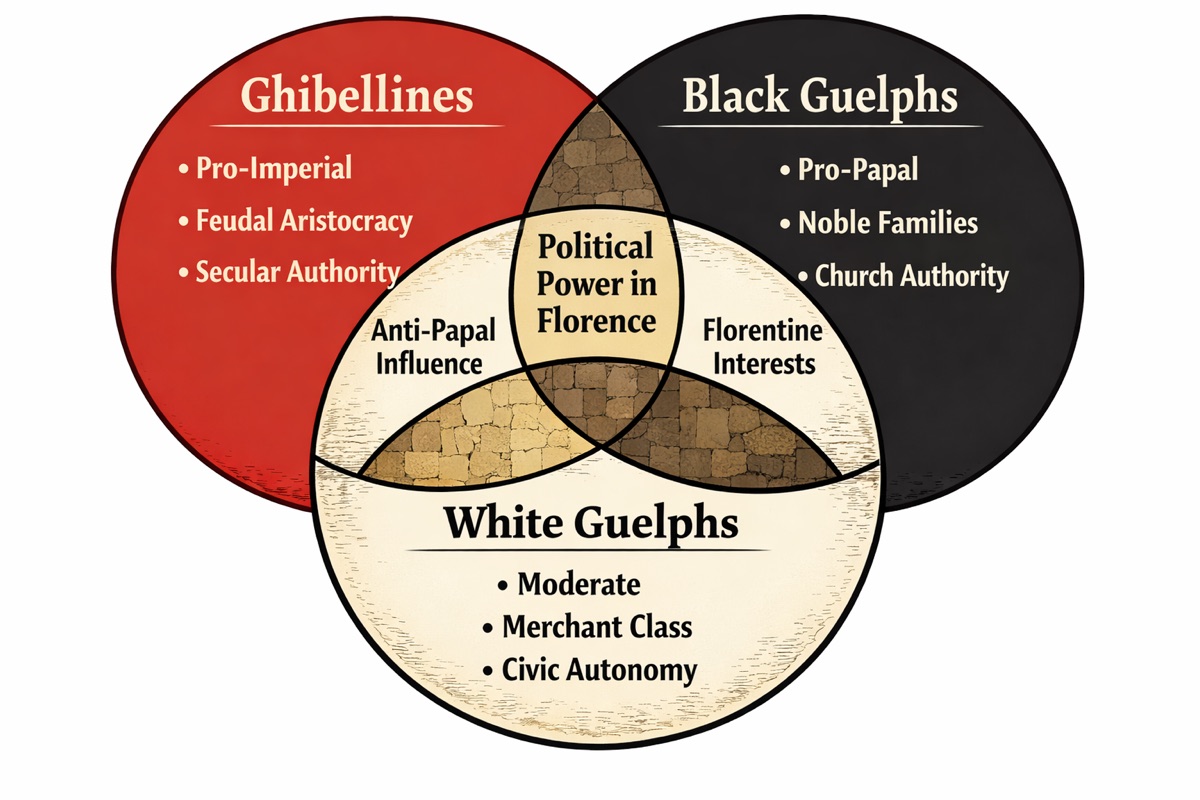
THE EVOLUTION OF DANTE’S POLITICAL PHILOSOPHY
Dante did not consistently identify with a single political faction throughout his life; his allegiances evolved in response to Florence’s volatile political landscape and his own philosophical maturation.
Dante’s Shifting Political Identity
| Period | Faction | Alignment | Notes |
|---|---|---|---|
| Early Career (pre-1295) | Guelph | General support | Florence was Guelph-dominated after 1266; Dante benefited from this civic order. |
| Mid Career (1295–1302) | White Guelph | Active supporter | Opposed papal interference; favored civic autonomy and legal reform. Dante served as a city prior in 1300 and voted to exile both White and Black leaders to reduce factional violence. |
| Post-Exile (after 1302) | Anti-Black Guelph / Imperial Sympathizer | Philosophical shift | After being exiled by the Black Guelphs (with papal backing), Dante’s writings—especially De Monarchia—advocated for a universal empire independent of papal control. |
Key Turning Points
- 1300–1302: As a White Guelph, Dante tried to mediate between factions but was ultimately exiled when the Black Guelphs seized power with Pope Boniface VIII’s support.
- Post-1302: In exile, Dante distanced himself from all Florentine factions. His writings condemned both papal corruption and factionalism, advocating for a transcendent imperial order.
Philosophical Evolution
Dante’s political thought matured into a critique of both ecclesiastical and civic corruption. In Inferno, he places corrupt popes (e.g., Boniface VIII) among the damned, and in Monarchia, he argues for the separation of spiritual and temporal powers.
The timeline below aligns Dante’s political evolution with key historical events and cantos from the Inferno, emphasizing his shifting allegiances and philosophical development.
Timeline: Dante’s Political Evolution and Inferno Cantos
| Year | Historical Event | Dante’s Political Phase | Inferno Canto Alignment |
|---|---|---|---|
| 1260 | Battle of Montaperti: Ghibellines defeat Guelphs | Dante not yet politically active | Canto X – Farinata degli Uberti, a Ghibelline leader, defends Florence from destruction |
| 1266 | Guelphs defeat Manfred; Ghibellines exiled | Florence becomes Guelph-dominated | — |
| 1295 | Dante enters politics as a White Guelph | Civic autonomy, anti-papal influence | — |
| 1300 | Dante elected Prior; White Guelphs exile Black Guelphs | Moderate reformist stance | Canto VI – Ciacco prophesies Florence’s factional strife |
| 1301–1302 | Pope Boniface VIII backs Black Guelphs; Dante exiled | Becomes anti-Black Guelph and anti-papal | Canto XV – Brunetto Latini, Dante’s mentor, symbolizes civic virtue lost in exile |
| Post-1302 | Dante never returns to Florence; writes The Commedia | Imperial universalism; critiques both Church and civic corruption | Canto XIX – Simoniacs (corrupt clergy); Canto XXI–XXII – Barrators (corrupt officials); Canto XXVII – Guido da Montefeltro, a fraudulent counselor tied to papal deceit |
Philosophical Shifts Reflected in the Inferno
- Early Cantos (I–VII): Dante’s personal confusion mirrors his political disillusionment.
- Canto X: Farinata’s noble defiance contrasts with factional destruction, foreshadowing Dante’s later admiration for principled leadership.
- Canto XIX: Dante’s fury at simony reflects his rejection of papal corruption post-exile.
- Canto XXVII: Guido da Montefeltro’s damnation for papal manipulation underscores Dante’s critique of Church overreach.