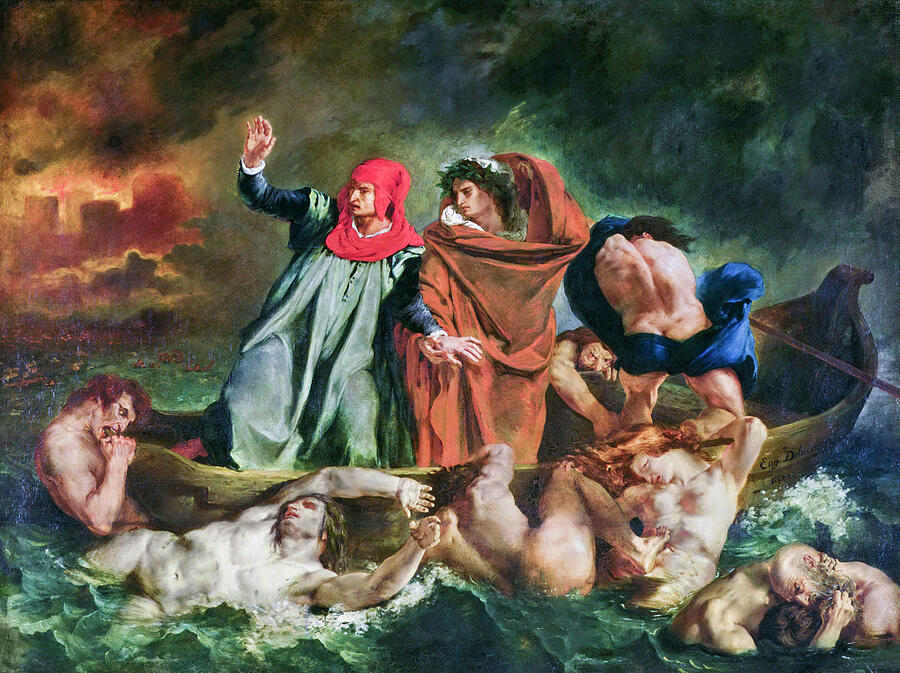
Inferno, Canto VIII
The Styx and the Walls of Dis. Class notes on Canto VIII of Dante's Inferno.
- 1. Compare the last line of Canto VII to lines 1-2. How do these lines support Boccaccio’s idea (for which no additional evidence has been found)?
Dante is backtracking to describe things that happened before he and Virgil reached the foot of the tower.
What do you make of lines 3-12?
The two little lights may be signal lights to Phlegyas telling him there are souls free of the Styx that he needs to retrieve and return to the slimy marsh. In which case, Phlegyas does not function as Charon does, ferrying souls, but as a patrolman keeping souls in the Styx. Since the two lights are described as “little” and “flickered far away,” they may be coming from the City of Dis where the rebellious angels are directing Phlegyas’s patrols.
Virgil explains that Dante’s question will be answered once they have gotten to the opposite side of the swamp, further supporting the idea that the Fallen Angels are signaling Phlegyas.
- 2. Who is Phlegyas?
He is the proud and wrathful guardian of the Styx and of the sinners punished therein. [Esolen’s note explains his back story in mythology.]
Why does he call Dante a traitor? (lines 16-18)
He believes he is an escapee from the Styx.
How does Virgil handle Phlegyas? (lines 19-21)
As he always does, by standing firm before him, but he does not include a reference to God.
How does Phlegyas’s response (in the form of an epic simile) connect him to the sinners he guards? (lines 22-24)
His resentment and seething with grief connect him to the both the wrathful and the sullen: His resentment is the beginning of anger (wrath). His shutting that anger inside is sullenness.
What do lines 25-30 contribute to our understanding of the contrast between Dante and the sinners doomed in Hell?
His living body has weight. As shades, their so not. [Virgil depicts Aeneas having the same experience in Charon’s boat in the Aeneid 6:412-416.]
- 3. In lines 31-42 and 52-54, how do Dante’s words differ from his encounters with Francesca (V. 115-117, 139-142) and Ciacco (VI. 58-59)?
For Francesca, he weeps with pity. For Ciacco, the sinner’s suffering weighs on his soul and causes him to cry.
He feels nothing but contempt for Argenti, calling him an “accursed spirit,” wishing him ill.
He even desires to see Argenti rent limb from limb by the other sinners.
How do Virgil’s words spoken in response to Dante’s treatment of Filippo Argenti differ from his earlier responses in those other cases? (lines 43-45, 55-57)
Though Virgil had criticized Dante’s compassion for the damned earlier (because it can indicate a disapproval of God’s Justice), he now praises his treatment of the wrathful sinner.
Notice that Virgil uses the term “indignant soul,” which refers to the golden mean between wrath and sullenness: righteous indignation. He goes so far as to say that Dante’s desire to see Argenti dunked “in this swill” is good. Dante’s view is now in harmony with God’s justice.
What surprising allusion does Virgil make in praising him? (line45)
His words of praise for Dante’s mother recalls the woman shouting out to Christ, “Blessed is the womb that bore You, and the breasts which nursed You!” – Luke 11:27
- 4. What do you make of Virgil’s comments on and Dante’s first glimpse of the city of Dis? (lines 66-78)
Dante gazes “wide-eyed” to see the shore of the Styx where the walls of the city stand.
In his advice to the pilgrim, Virgil refers to the great hosts (the Fallen Angels that guard the city’s gate) and makes a pun by calling the denizens of that city “grave.” The first sinners they will encounter inside the walls will be the heretics, who are kept in graves.
Dante perceives the city as having mosques (line 71). This reference to the Muslim world evokes those people whom Dante and the rest of Europe perceived as the most hostile religious and military force in the world. The fact that these structures “glow and burn” associates them with fire. Although fire can be evocative of holiness, renewal, and purification, in this context it evokes the other side of that symbolic image: destruction, war, evil, and the demonic. This is the first time the pilgrim has seen fire in Hell.
That the walls are made of iron indicate that from here on down all sins punished are the result of the hardened will, note the whims of appetite. [Cf. the iron tower at the entrance to Tartarus in the Aeneid,]
- 5. Where does Phlegyas deliver Dante and Virgil?
At the entrance of the city of Dis. [This detail lends some support to the theory of some critics that Phlegyas serves the Fallen Angels.]
Re-read lines 82-93. How do these lines identify the guardians of the Sixth Circle (lying just inside the wall of the city of Dis)?
Dante describes them as having “rained from heaven” (line 82) This phrase alludes to Rev. 12:7-9 which reads, “7 And war broke out in heaven: Michael and his angels fought with the dragon; and the dragon and his angels fought, 8 but they did not prevail, nor was a place found for them in heaven any longer. 9 So the great dragon was cast out, that serpent of old, called the Devil and Satan, who deceives the whole world; he was cast to the earth, and his angels were cast out with him.”
How to the Fallen Angels respond to Virgil’s signal that he wishes to speak to them privately? (lines 84-93)
They invite Virgil to come alone but to tell Dante to go back the way he came which they call “his mad way!” They do not believe Dante would be able to return alone. And they intend to keep Virgil with them.
- 6. Look at lines 94-96. What rhetorical device does this tercet make use of?
This tercet is an example of apostrophe. It is one of many times that Dante the poet will pause his narrative to address his audience directly.
What is the function of this apostrophe?
It is a direct statement to the reader that Dante the pilgrim feared for his life in a way he had not felt since Virgil proposed leading him through the afterlife.
How do lines 98-102 fill out his response to the prospect presented by the Fallen Angels?
Dante respects what Virgil has done for him (lines 97-99). He doesn’t want to be separated from Virgil and would prefer that his guide turn around and take him back (lines 100-102)
How does Virgil reassure Dante? (lines 103-108)
First, he reminds Dante that his journey has been ordained by God. He then advises him to find strength in hope which will “fortify [his] soul in its fatigue.” Second, he assures Dante he will not abandon him.
- 7. Do Virgil’s words put Dante at ease? (lines 109-111)
No, he continues to shift back and forth between confidence and fear.
Though Dante cannot hear the exchange between Virgil and the Fallen Angels, he can observe. What may we assume Virgil said to them?
He probably said something very much like, “This has been willed where what is willed must be.” In other words, he appeals to God’s will concerning Dante’s journey.
What can you further conclude about the motives for the Fallen Angels withdrawing inside the walls and slamming the gate shut? (lines 112-117)
Virgil’s response must have been direct and, therefore, short. The fact that the Fallen Angels retreat and slam the gate recalls that they remember when Christ set permanently open the Gates of Hell. (lines 124-126)
Consider lines 118-119. What do these lines suggest about a potential flaw in Virgil?
Virgil, his body language suggesting defeat, may have been overconfident in his own power over the demons of Hell.
Clearly, God is in control, not Virgil.
How does his tone change in lines 120-123.
Though his “brow was shorn/of all his boldness as he sighed,” he becomes confident, even defiant of the Fallen Angels, insisting he will “have the victory.”
He also cautions Dante to “ignore my anger.” Further, though he knows the Fallen Angels will try to fight, Virgil will still win.
How do the final four lines of the canto support Virgil’s confidence? (lines 127-130)
Virgil somehow knows help is on the way even as he speaks.