Inferno, Canto X
The Heretics. Class notes on Canto X of Dante's Inferno.
- 1. The heretics are grouped by their heresy according to Canto IX.130. What is the particular heresy Dante chooses to focus on? (lines 13-15)
That the spirit dies with the body; denial of life after death, that is, resurrection
How does Virgil define the heresy of Epicureanism?
They believed that “spirit dies when body dies.”
How does this definition and translation make clear the contrapasso applied to heresy?
The souls of the heretics will be eternally buried with their bodies. They denied the resurrection, so they will stay in their graves.
In line 6, what wish does Dante seek to be satisfied?
He wants to see Farinata (and others) whom Ciacco said he would encounter further down. (VI.79-87)
- 2. For some reason, Esolen has translated sepolcri as “graves.” You may be able to guess that the Italian word means “sepulchers.” Consider Psalm 49:11 to determine Dante’s inspiration.
10 For all can see that the wise die,
that the foolish and the senseless also perish,
leaving their wealth to others.
11 Their tombs will remain their houses forever,
their dwellings for endless generations,
though they had named lands after themselves.”
The imagery of the heretics and their punishment parodies medieval imagery of the resurrection. Consider each of the following: lines 8-9, 32-33, and 52-57.
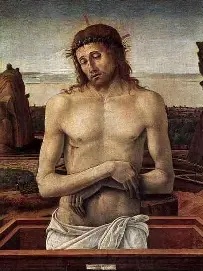
8: The lids to their sarcophagi are open – though they cannot leave them.
9: There are no guards (the guardians of the circle seem to have disappeared)
32-33: Farinata rises to “His full height from the waist up” (in a manner recalling the imago pietatis in contemporary Christian iconography as well as the iconography of the dead rising from their graves at the Last Judgment) – Farinata rises not to glory but to continue his earthly political battles
52-57: Cavalcante rises somewhat frantically, echoing resurrection but in a distorted, hopeless manner – his rising is a grotesque parody of the Last Day risings
Dante’s visiting the lidless tomb itself recalls the visit of the three Marys to Christ’s empty tomb. The parody is that the tomb Dante visits is not empty.
Lines 10-12: After the Final Judgment, the heretics will “bring back their bodies to the tomb” which “will [then] be bolted” The heretics’ incomplete resurrection prefigures their final burial.
How does this imagery in parody contribute to understanding the contrapasso effected in this circle?
The heretics denied the resurrection of the body, yet they are punished in a setting that constantly parodies it.
They denied the immortality of the soul, but now they suffer eternally.
They denied the resurrection of the body, but now they rise in a distorted, punitive imitation of it.
- 3. How does Farinata recognize Dante as a fellow Tuscan?
He recognizes his accent. [Compare line 25 to Matthew 26:73 – “After a little while, those standing there went up to Peter and said, ‘Surely you are one of them; your accent gives you away.’” This is the first of other references to Christ’s Passion and Resurrection.
Consider how does each of the following lines express an aspect of Farinata’s character: lines 22-24, 35-36, 40-42, 45, 46-48, 73-76, 77-78, 82-84, 88-93, and 110-111/118-120.
22-24: He is perceptive and polite.
35-36: The emphasis on Farinata’s chest and brow evoke his pridefulness and suggests that he somehow holds Hell itself in scorn [Only the description of Satan in the final canto – “he raised his brow against his Maker still” (XXXIV:35) – shares a similar description.]
40-42: He looks upon Dante with disdain, asking to which stratum of society Dante belongs, a comment which itself suggests and obsession with worldly honors
45: His raised eyebrow again denotes his disdain
46-48: He speaks of Dante’s family – and party – with pride regarding his expelling them from Florence
73-76: He is intense and self-disciplined, maintaining his posture rigidly and picking up his conversation exactly where Cavalcante interrupted his discourse; in the Italian Dante here describes Farinata with the word “magnanimo,” which has a positive sense – “great-hearted one” – and a negative sense – “ambitious, overweening one”
77-78: The failure of his family/party in Florence, he claims, hurts him worse than does his fiery sepulcher; it further develops an arrogance in him
82-84: He fails to comprehend why he is hated in Florence and why his descendants continue to suffer
88-93: He loved Florence and was the sole opposition among his fellow Black Guelfs to resist the razing of Florence
110-111/118-120: After Dante asks him to explain to Cavalcante that his son still lives, Farinata says thousands lie in the tomb they share, names two and then abruptly declares he has no more to say [You should note that Farinata was father-in-law to Cavalcante’s son who married Farinata’s daughter Beatrice, yet he acknowledges Cavalcante in no way.]
- 4. How does Cavalcante’s appearance contrast with Farinata’s physically? (lines 52-54)
While Farinata rises tall and proud, Cavalcante appears to be kneeling, “visible to the chin.”
Why is he disappointed when he sees Dante? (lines 55-60)
First, he longs “to see if someone else was there with” Dante. Disappointed and “his little hope . . . doused,” he weeps, He cannot understand why, if Dante is traveling through Hell “by means of genius at its height (Dante’s own genius), Guido, his son, isn’t with the pilgrim.
What causes him to sink back into the sarcophagus? (lines 67-72)
His misunderstanding Dante’s use of the past tense in speaking of Guido leads him to believe his son is dead. He seems unable to deal with that possibility.
How would you contrast the characterizations of Farinata and Cavalcante in light of this idea from critic Robert M. Durling?
| Farinata | Cavalcante |
|---|---|
| He is heard before he is seen Speaks confidently and with intention Speaks gravely and ceremoniously Must inquire into Dante’s family Remains calm, immobile, and self-contained |
He first peeks over the edge of the sarcophagus He looks anxiously about before speaking Speaks entirely without ceremony Already knows of Dante’s connection to his son Appears excited, in motion, and without dignity |
- 5. How does Farinata answer Dante’s question (lines 95-99) about the foreknowledge of the damned? (lines 100-108)
They can see the distant future, but the closer they come to the time of their foreknowledge events become cloudy and obscure to the point they no longer see them. They can only know of the present situation if someone informs them.
How does this condition contribute to the punishment of all the denizens of Hell?
When time itself ends, they will see (and know?) nothing but their suffering.
Farinata’s explanation involves an inversion of the natural pattern of memory (distant things are indistinct, closer ones clear). The metaphor of gad light, along with the reference to God as the intellectual sun, makes it clear that what Farinata is describing is like evening twilight, in which distant things, outlined against the bright horizon, are more easily visible than closer things, already enveloped in darkness. The metaphor of the end of time as like the closing of a door focuses a parallel with the future closing of the tombs. Until the Last Judgment, the damned will enjoy some vestige of the “good of the intellect,” bust afterwards hell will be as devoid of “light” as midnight.
- 6. The heretics can be considered to deny the eucharist. Do you see any support for the idea that this canto offers a critique of heresy through a eucharistic lens?
The Tombs as Anti-Altars / Anti-Tabernacles (lines 1-21)
In Christian liturgy, the altar and tabernacle are the places where the consecrated Body of Christ is made present.
In Canto X, Dante walks among stone tombs glowing with fire, each containing souls who denied the resurrection of the body.
These tombs function as inverted altars:
Instead of containing the Body of Christ, they contain bodies that denied the Body.
Instead of being places of life-giving presence, they are places of death and absence.
Instead of being loci of communion, they are loci of isolation.
Theological logic:
The Eucharist presupposes: the Incarnation, the Resurrection, and the real presence of Christ’s Body
Epicurean heresy (“the soul dies with the body”) denies the very metaphysics that makes Eucharist possible. Thus, the fiery tombs become a negative Eucharistic sign—a parody of the sacramental container.
The Burning of the Tombs as an Inverted “Real Presence” (lines 22-30 – the tombs heated by divine justice)
In the Eucharist, the real presence of Christ is a presence of grace.
In Canto X, the “real presence” in the tombs is the real presence of punishment.
The fire that suffuses the tombs is a perverse analogue to the fire of divine love that, in Christian mysticism, is associated with the Eucharist.
Theological logic:
Where the Eucharist is the sacrament of unity, the heretics experience the anti-sacrament of disunity—a presence that burns rather than heals.
Farinata’s Half-Risen Body as a Parody of Resurrection (lines 31-45 – Farinata rises “from the waist up)
The Eucharist is inseparable from the doctrine of the Resurrection of the Body.
Farinata rises from his tomb as if resurrecting, but only partially:
He stands “as if he held Hell in great disdain.”
His posture mimics the elevated, upright body associated with resurrection iconography.
Yet this “resurrection” is incomplete, distorted, and powerless.
Theological logic:
Farinata’s half-rising is a mock resurrection, a visual contradiction of the Eucharistic promise of full bodily restoration.
His body rises, but not to glory—only to continue the debate of earthly politics.
Cavalcante’s Sudden Rising as a Second Parodic Resurrection (lines 52-72)
Cavalcante “lifts himself up on his knees,” another gesture resembling a partial resurrection.
His rising is motivated not by divine summons but by anxiety for his son.
The Eucharist is the sacrament of divine filiation; Cavalcante’s gesture is a tragic distortion of that relationship:
He rises not toward God but toward human lineage.
His hope is misplaced, and his “resurrection” collapses back into despair.
Theological logic:
This is a second anti-Eucharistic sign: a rising that leads not to communion but to misunderstanding and grief.
The Heretics’ Knowledge of the Future as a Broken Eschatology (lines 97-108)
The Eucharist is oriented toward the eschaton (“until He comes again”).
The heretics’ knowledge is inverted eschatology:
They see the future dimly.
They lose all knowledge after the Last Judgment.
Their eschatology is anti-sacramental:
No resurrection
No restored vision
No communion with God
Theological logic:
The Eucharist anticipates the fullness of resurrection; the heretics anticipate the collapse of their own consciousness.
This is the ultimate negation of Eucharistic hope.
- 7. What is the significance of Virgil’s words in the final tercet? (lines 127-129)