Inferno, Canto XIX
Eighth Circle, Bolgia 3: Simony. Class notes on Canto XIX of Dante's Inferno.
- 1. What rhetorical device does the Poet use in lines 1-3?
Apostrophe
Who is Simon Magus?
He is the magician converted by the apostle Philip (Acts 8:9-13). When he later tried to buy the power to confer the Holy Spirit, Peter rebuked him for thinking the gift of God might be purchased for money (Acts 8:14-24). His name is the derivation of the word “simony.”
The apocryphal Acts of Peter recounts a story of Simon serving as the Emperor Nero’s chief magician. The apostle Peter bests Simon in a series of magic competitions (based on Moses’ and Aaron’s duel with Pharaoh’s magicians). In his final defiant act, Simon flies (held up by a demon) until Peter’s prayers force the demon to let the magician fall, resulting in his breaking his leg in three places.
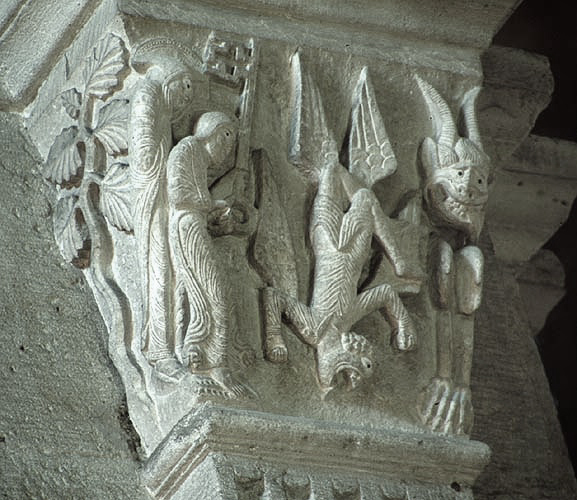
Note, too, that both the magician and the apostle of the same name Simon. This is precisely the kind of situation that fascinated the faithful in the Middle Ages.
In lines 1-3, to whom does Dante refer to as “you wretched crew/of his disciples”?
It may be interpreted to refer either to all the sinners guilty of simony or to the specific set of simoniac popes.
“The wretched crew” is also called “Rapacious wolves,” a use, once more, of the she-wolf from Canto I as a symbol of avarice.
How do lines 2-4 reflect both Revelation 21:2 and the first bolgia of Circle 8?
The Scripture speaks of the Church as the bride of Christ in a holy union while the fourth line speaks of pandering that bride in exchange for silver and gold.
In his consecration to his office, a bishop puts on a ring that symbolizes his marriage to his diocese, the “bride of Christ.”
What precisely is simony?
Simony is applied to traffic in all sacred things, particularly to the buying and selling of the powers of the priesthood – including, but not limited to preaching and the sacraments – or of the priestly office itself. In Dante’s time, simony extended to nepotism in distributing church offices.
What trumpet does Dante call to be sounded for the simonists?
It could be the trumpet in Hosea 8:1— “Set the trumpet to your mouth!
He shall come like an eagle against the house of the Lord,
Because they have transgressed My covenant
And rebelled against My law.”
Or, it could be the trumpets sounded in Revelation 8-9.
- 2. What rhetorical device does the Poet use in lines 10-12?
Apostrophe
Whom does Dante address in these lines?
“Highest Wisdom,” an epithet for God
For what is Dante offering praise?
He is praising the design of Heaven, earth, and Hell, focusing on the justness of the design. In other words, in the case of Hell, he praises the design not only of the topographical structures in Hell but of the way Hell is designed to accords the punishments he witnesses.
Of what exactly does the punishment of the simonists consist? (lines 16-30)
Sinners are placed upside down in holes that resemble the baptismal fonts in Dante’s home church of San Giovanni. Only their legs, from the knees to the feet protrude from the hole. The soles of their feet are set on fire, causing them to “kick and wrench their joints” with such vigor that the motion could have “snapped twisted ropes or cords in two.”
What is the contrapasso in this punishment?
Because the holes are explicitly compared with baptismal fonts, the immediate reference is to an inversion of the iconography of baptism, which typically showed the baptized in a font (or a river), appearing from the waist up.
Inversion is a major governing principle in this canto, for simony represents a drastic inversion of values. The simonists headlong fall repeats Simon’s fall as well as Satan’s.
Moreover, since simony is most directly connected to popes and other clergy, the inverted punishment is a parody of St. Peter’s upside-down crucifixion. In the apocryphal Acts of St. Peter, out of humility Peter asks to be crucified head down, regarding himself as unworthy of a death exactly like that of Christ.
The use of the word “anointed” evokes the chrism used both in baptism and in extreme unction. In those sacraments the head is anointed, but here in this inversion, the feet are anointed with a flame that may itself be a perversion of the Pentecostal flames that danced on the heads of the apostles. The Catholic sacraments of ordination and confirmation also involve anointing with chrism (oil). These sinners have abused their holy office for monetary gain by requiring payment for the sacraments.
Dante’s use of bocca (mouth) for the opening of the hole into which the damned pope is placed suggests that eventually he will be eaten and digested by Hell itself once the next simoniac pope comes to his eternal station.
The parody of Pentecostal fire may also allude to the misuse of extraordinary gifts of persuasion found among those punished among the heretics, the sodomites, and – later – the false counselors.
- 3. Why do Dante and Virgil descend into the pit of the third bolgia? (lines 31-39)
Dante notices one sinner’s feet with a flame redder than the flames on others’ feet and wants to know his identity.
Why does Virgil lead Dante to the “farther bank.” (line 35)
The further bank of the bolgia is not as high as the nearer one because the slope of the Malebolge cuts away to the topmost part of each successive pouch. For this reason, Virgil will lead Dante over the third bolgia to the fourth embankment only to climb down into the third from that vantage point.
How do Dante’s word in lines 37-39 place him in stark contrast with Nicholas III?
Dante’s submissiveness to his lord, acknowledging Virgil’s awareness of his wishes, is surely meant to contrast with Nicholas’s rebellious offense to his own lord, Jesus Christ.
How do lines 49-51 continue the imagery of inversion?
First, in Florence at the time, professional assassins were placed head down in a pit and buried alive. Here the pilgrim has adopted toward the condemned pope the role of a priest hearing the confession of a layman. The imagined priest is most likely a Franciscan friar known for their extreme humility which stands in stark contrast to the corrupt pope. (If so, it is ironic that Nicholas III was a special protector of the Franciscan Order.
What does Dante cleverly manage to accomplish in lines 52-57?
Dante has Boniface’s sins summarized and his damnation predicted by another pope in 1300, while Boniface was still alive.
What does Nicholas mean in line 54 by “The writing has deceived me by some years!”?
Nicholas believed Boniface was to die in 1303 (as he did). The “writing” is the book of the future, which the damned my read until the events approach.
How does Nicholas identify himself? (lines 69-70)
He declares that he “wore the mangle of the pope.” Identifying himself as an Orsini points to his family and thereby identifies him.
What does he confess his sin to have been? (line 72)
He “stashed great wealth to advance my cubs,” confessing his nepotism accomplished by perverting his office.
How do lines 73-75 provide another parody of the teachings and practices of the Church?
With the head of the latest simoniac pope pushing down the one before him, his head pushing on his predecessor’s feet parodies the apostolic succession in this inversion.
- 5. Lines 90-117 constitute Dante’s longest denunciation of the corrupt clergy in the Commedia. What do you make of his denunciation?
Open Question
How do you interpret lines 106-111?
Alluding to Revelation 17:1-5, the seven heads and ten horns are usually taken to be the seven sacraments and the Ten Commandments, chief institutions of the New and Old Laws. In the New Testament, the “harlot” was associated with Babylon and pagan Rome; for Dante, as for the “Spiritual” Franciscans, she is the corrupt clergy, led by the popes, her “whoring” the Church’s involvement in temporal affairs and Clement V’s subservience to Philip IV.
With what other sin does Dante associate with the greed in the sin of simony? (lines 112-114)
Idolatry
Do you have any questions about the Donation of Constantine?
The Donation of Constantine is an 8th-century forgery that claimed the Roman emperor Constantine the Great had granted the pope supreme spiritual and temporal authority over Rome, Italy, and the entire Western Roman Empire.
Alleged 4th-century origin (fictional)
The document presents itself as a decree issued after Constantine’s supposed cure from leprosy and baptism by Pope Sylvester I, granting the papacy vast lands and political supremacy. This narrative drew on earlier legends such as the Legenda S. Silvestri.
Actual composition (mid-8th century)
Modern scholarship places its creation between 750–800, likely by a cleric in Rome during a period when the papacy sought independence from Byzantine control and support from the Frankish rulers (e.g., Pepin the Short).
Medieval use and influence
Throughout the Middle Ages—especially the 9th to 13th centuries—the Donation was invoked to justify papal claims to political authority, territorial rights, and supremacy over secular rulers. It appeared in the Pseudo-Isidorean Decretals, further embedding it in canon law traditions.
Humanist exposure of the forgery (15th century)
In 1439–1440, the Renaissance scholar Lorenzo Valla used philological analysis to prove the document was a forgery, demonstrating linguistic anachronisms and historical impossibilities. Although doubts had existed earlier, Valla’s work decisively discredited it.
Long-term legacy
Even after being exposed, the Donation remained symbolically important as an example of how forged documents shaped medieval church-state relations and fueled conflicts such as the Investiture Controversy and East–West tensions.
What do you make of Virgil carrying Dante back up the bank? (lines 124-126)
Dante has been overcoming his fear and reticence. He has just denounced the sins of the papacy, showing no sympathy for Nicolas III. Reason is carrying him.