Inferno, Canto XXV
Eighth Circle, Bolgia 7: Thieves (continued). Class notes on Canto XXV of Dante's Inferno.
- 1. Note that the opening tercet of this canto could easily have been the concluding tercet of the previous canto. Were you able to connect him to Capaneus as a blasphemer before you reached line 15?
This is an OPEN QUESTION. Both are motivated by pride against God.
How do you interpret line 4?
According to Guido da Pisa, the serpents become Dante’s “friends.” They undo the reason for the curse laid on the serpent in the Garden of Eden; these serpents are doing something praiseworthy despite their unappealing ancestry.
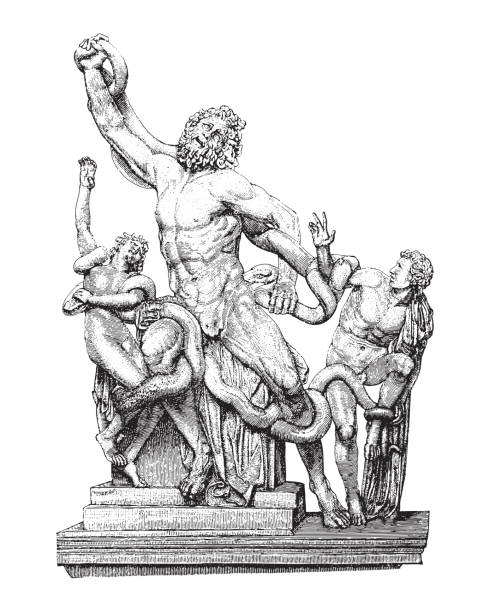
Compare lines 5-9 to the drawing of the Laocoon, a sculpture of the Trojan priest of Apollo (along with his sons) attacked by twin sea serpents. They were sent by Athena after the priest threw a spear into the Trojan Horse, warning the Trojans not to bring the gift of the Greeks within the city walls. The episode is related in Aeneid II.201-224. Do you see any reason to make such a connection?
What do you make of the apostrophe to Pistoia in lines 10-12?
Sometimes the enemies of Pistoia (Florentines, for example) asserted that the origin of the city’s name arose from the “pestilential” revolt of Catiline, the Roman traitor.
In line XXIV.88, Dante connects the serpents and the thieves with pestilence, “Let Libya with its deserts boast no more!/If it breeds spearer, slitherers, hot chelydri,/cencri erect and twin-head amphisboenes,/Never had so many nor so venous pests/has it all of Ethiopia borne, and all the land that looms on the Red Sea.”
- 2. In the Aeneid, Cacus is not described as a centaur but as a semihomo, a “half-man,” gigantic, covered with fur, and, as a son of Vulcan (not of Ixion, father of the centaurs), able to breathe fire. How has Dante changed Virgil’s portrayal of the creature?
Dante makes him a centaur, referring to Cacus’s “brother centaurs” who patrol the First Round of the Seventh Circle. (line 28)
In the Aeneid, Cacus breathes smoke and fire, but, in Inferno, a dragon sits on his back (lines 22-24) breathing fire, “scorching whatever soul he hit upon.”
In the Aeneid, Hercules strangles Cacus, but in Dante’s adaptation, Hercules beats the monster to death, striking 90 more blows than are needed to kill him.
In the Middle Ages, Cacus was often seen as related to Satan, since Hercules was frequently understood to represent Christ.
Why is Cacus not consigned to the Seventh Bolgia of the Eighth Circle? (line 29-30)
He stole the cattle of Hercules.
What is his function in Inferno? (lines 16-18)
Though a sinner himself, he seems to be taking vengeance on Vanni Fucci. He may be a sort of sub-guardian.
- 3. In lines 34-36, the sinners featured shift from Pistoia (Vanni Fucci) to Florence. Who are they? (lines 43,68, 140, 148, and 151 [with Esolen’s not on that final line])
Cianfa, Agnello, Buoso, Puccio, and Francesco
How is this list of names inconsistent with line 35?
Line 35 states, “three spirits suddenly appeared below.” Yet, five names are given over the course of the rest of the canto
What may have caused this confusing inconsistency?
The highly detailed transformations suggest that Dante saw three human spirits while the other two appeared as snakes.
- 4. What is going on between Dante and Virgil in lines 40-45?
Dante’s gesture (holding his finger to his lip) is meant to halt Virgil from talking so as to follow the words spoken by one of the Florentine thieves.
What rhetorical device does Dante the Poet employ in lines 45-48?
An apostrophe. It is the sixth address to the reader in this canticle.
What is its purpose?
It stresses the incredibility of the events and the narrator’s reliability.
- 5. Lines 50-138 present an incredibly detailed description of a metamorphosis. Esolen correctly translates serpente as “serpent.” Why then does the translation seem wrong? (line 50)
He describes the “serpent” as having six feet. It must be some manner of lizard. What Dante calls serpents might be rendered “reptiles” by moderns.
Essentially, what does this “serpent” do to the sinner in human form? (lines 49-57)
The creature throws itself on to the human and clings to him. With its middle pair of feet it clasps the human’s abdomen and with its forward pair of feet grasps his arms while sinking its fangs to bite both cheeks of his face. It extends its hind feet along the human’s thighs, flipping its tail between the thighs “and on up/the sinner’s loins to clamp behind his back.”
What happens next (lines 61-63).
The two beings meld into one, “glued and fused together,” their distinctive coloring melting into something utterly different.
Who are the two souls involved in this fusing? (lines 43 and 68)
Cianfa and Agnel (Agnello)
Which is in serpent form and which in human form?
Cianfa must be the serpent since those calling for him cannot see him, leaving the sinner in human form to be Agnel (Agnello).
How might line 69 be understood as a parody of the dual nature of Christ as some commentators have suggested?
This is an OPEN QUESTION
How does Dante the Poet sum up this episode (lines 70-78). In other words, what is the final image of the metamorphosis involving Cianfa and Agnello (Agnel)?
The serpent and the spirit become “two figures mingled in one face, where the two faces had been lost.” Further, “Out of four bands of flesh they formed two arms;/the thighs and calves, the belly and the chest made members that no man has ever seen./ Each former countenance was canceled out; the image in perversion seemed both two/and nothing—and as such it slunk away.”
- 6. Consider this bolgia’s third and most detailed metamorphoses related in lines 85-138. In lines 85-87, where does the serpent bite its victim?
In the navel, “where the fetus takes its food.”
What is the first indicator of a coming transformation (lines 91-93)
The victim emits smoke from his wound while the snake emits smoke from its mouth.
What is the rhetorical device employed in lines 94-96 and lines 97-99?
Apostrophe
What is the purpose of both?
Dante is claiming to be the superior of the two named ancient poets who described metamorphoses.
What is the purpose of lines 100-102?
Dante argues what sets his “transformation” above those of both Lucan and Ovid: he has described a metamorphosis unlike any of theirs where “their forms/were ready to change matter with each other.”
Moreover, he claims that he is not making this up, but merely observing “reality,” God’s vengeance on the floor of the seventh bolgia.
Think of him as saying, “Let fictive poets yield to this new Christian teller of truths revealed, the humble scribe of God.” We do not have to believe this claim, but we can sense that it is being lodged.
Detail the transformation of man to serpent or serpent to man (lines 103-138)
| Serpent into man | Man into serpent |
|---|---|
| 1) its tail becomes legs (l. 104) 2) its hide becomes skin (l. 110) 3) its front paws become arms (l. 113-114) 4) its rear legs become a penis (ll. 115-116) 5) its body grows hair (l. 119-120) 6) its posture goes from prone to erect (l. 121) 7) its snout becomes a face (ll. 124-128) 8) its hiss becomes a voice (ll. 134-135) |
1) his feet and legs up to the thigh cling together becoming serpentine (ll. 105-108) 2) his flesh hardens into scales (l. 111) 3) his arms recede into his serpentine body (l. 112) 4) his penis splits into “two paws” (l. 117) 5) his body loses its hair (l. 120) 6) he falls to the earth on his belly (l. 121) 7) his face becomes a reptilian snout (ll. 130-131) 8) his tongue becomes forked so he hisses (ll. 133-137) |
How does line 116 recall the Genesis account of the Fall?
This hiding of the genitals begins with the use of fig leaves by Adam and Eve in Genesis 3:7.
What are the names of the two sinners involved in this complicated metamorphosis? (lines 140-141 and Esolen’s note to line 151).
Buoso has become a serpent and Francesco has become a man.