Introduction to Dante Handout
A student handout on the ideas behind the Inferno: the tripartite soul, love, and the order of Hell.
Dante believes the way to beholding of beauty via an understanding of love is the goal of a human life.
The tripartite soul
- Reason
- seeks truth, wisdom, and knowledge
- loves reasoning and aims at what is good
- meant to rule the two inferior parts
- Spirit
- Source of courage, indignation, ambition, and righteous anger
- Allies with reason when properly trained
- Responsible for honor and moral resolve
- Appetites
- Desires bodily pleasures: food, drink, sex, wealth
- Largest and most unruly part
- Must be governed by reason, with help from spirit
The cardinal virtues are built on the harmony of the soul’s parts. The virtues correspond to the parts and their harmony with one another:
- The right functioning of the reason produces wisdom
- The right function of the spirit produces courage
- The right functioning of the appetites produces temperance
- The right functioning of the parts together produces justice
Inferno is an expression of Dante’s love of justice, not in the sense of American courtroom or protest but in the sense of Aristotle’s analysis: “the giving of each his due.” Dante communicates this sense by involving readers deeply in the political conflict between Ghibellines and Guelfs. He seeks to understand and for the reader to understand both the source and the end (telos) of true authority.
Esolen perceives a profound connection between the telos of true authority and that of true beauty. For Dante objective beauty lies in the “vision of God, both Unity and Trinity, and of the incarnate Christ, God and Man, which is the end or goal of all rational beings, as it is the end or goal of the Comedy itself.”
Dante argues for a division of power on Earth as ordained by God Himself.
- The Empire exercises temporal power.
- The Papacy (the Church) exercises spiritual power.
- Working together, their right goal is to provide both a guide (Papacy/Church) and a curb (Empire).
Dante’s conception of both the world and the beauty of the world rests on three truths:
- Things have an end (telos).
- Natural Law and Sin
- Aristotle: man’s telos is happiness. All other things a man pursues he pursues because he believes they will make him happy. In fact, man’s happiness lies in his fulfillment of what makes him man: his reason, which distinguishes him from all other living beings.
- The fulfillment of reason, according to Aristotle is accomplished by discovering and holding to natural law. Natural law is “justice held to be common to all humans and derived from nature rather than from the rules of society (the latter rules being called positive law). As Lutherans, we see this law in the Ten Commandments. However, we also see it in Genesis.
- Further, there is beauty in the created world because beauty is implicit in whatever God creates. He called what He created good, whereby it is necessarily beautiful.
- Working against the telos of something or someone is to act against both its good and its beauty. As Esolen explains, for Dante “sin involves an absurdity, a corruption of what should make lovely sense, and it is an affront against the wise Creator.
- The components of the poem – numerological symbolism
- Each canticle is composed of thirty-three cantos – a number equal to Christ’s age at the time of the Crucifixion. [The first canto of Inferno may be regarded as a proem to the whole epic.]
- The entire poem consists of one hundred cantos, one hundred being ten times ten - ten being regarded as a perfect number.
- The number three recurs throughout every part of the poem, three being the number of the Trinity.
- The epic is divided into three canticles: Inferno, Purgatorio, and Paradiso.
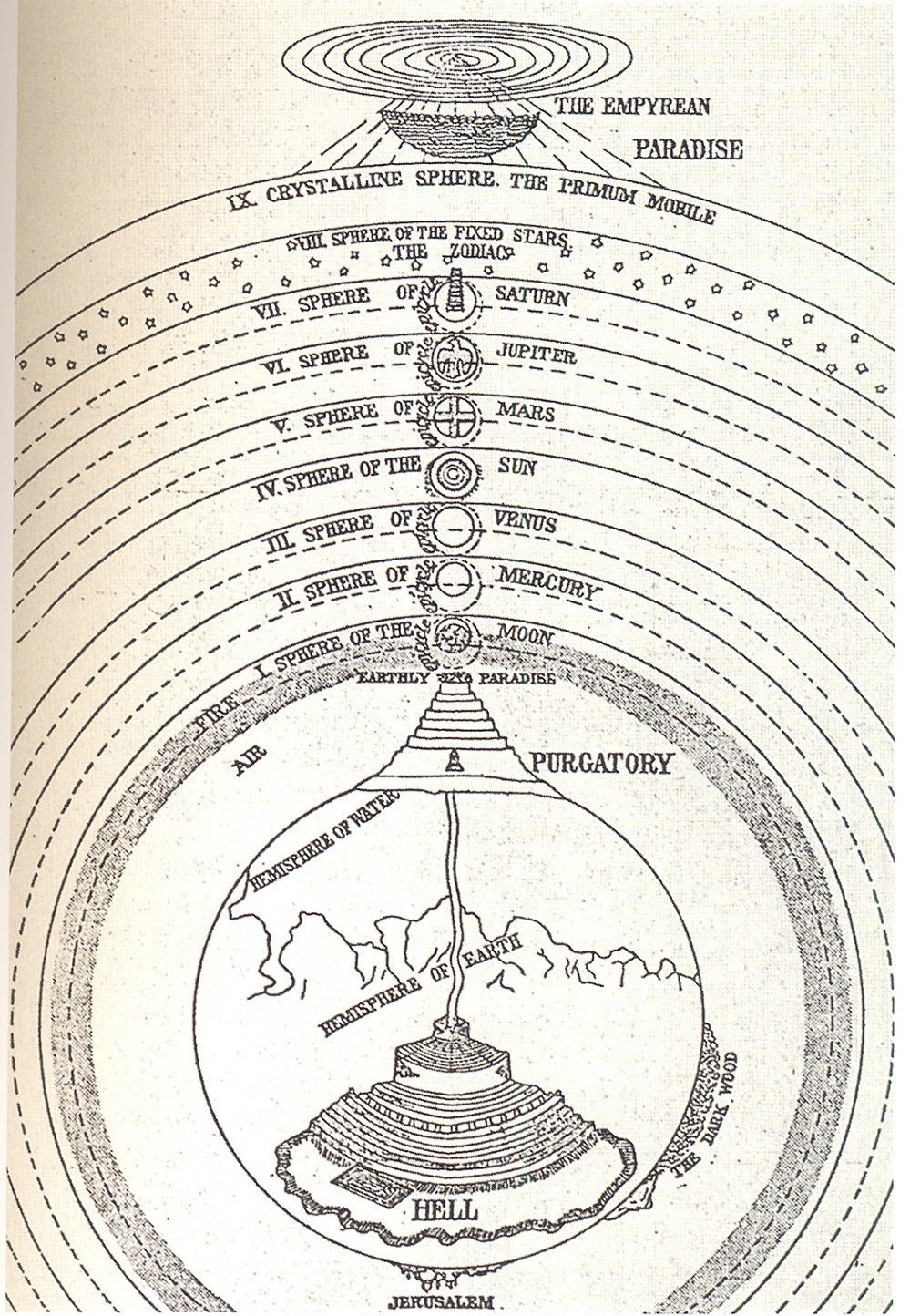
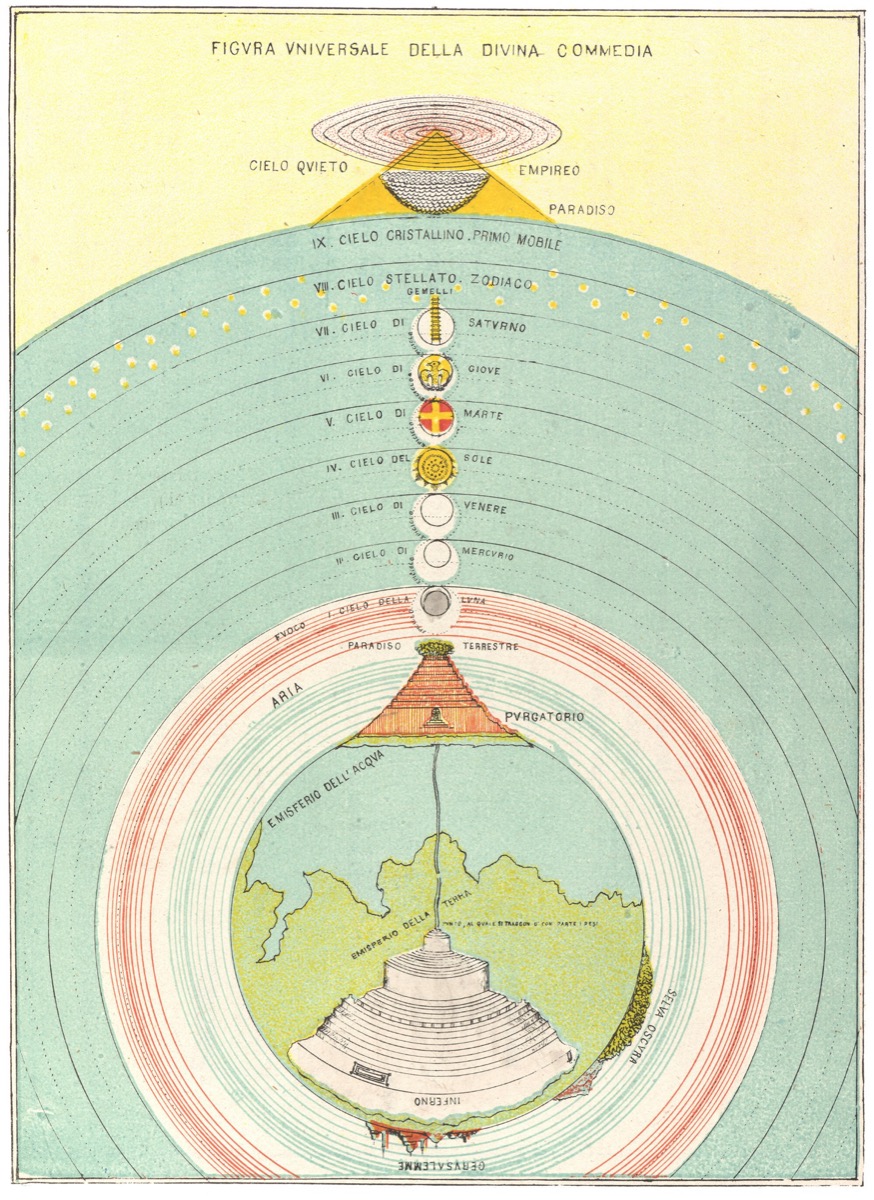
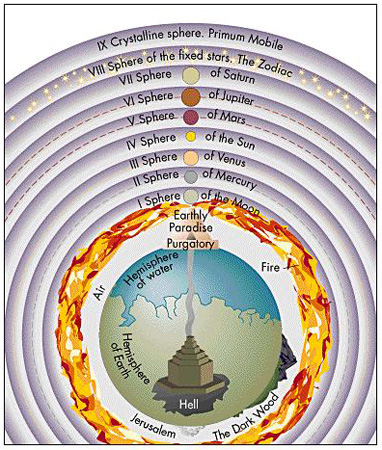
- The Dantean/Ptolemaic universe is divided into three major parts: Earth, Heavens, Empyrean
- The rhyme scheme Dante invented to write the Commedia - terza rima - is based on threes.
- Each stanza – tercet – consists of three lines.
- The first and third lines in each tercet rhyme.
- The second line in any given tercet sets the rhyme for the first and third lines of the succeeding tercet.
- Natural Law and Sin
- Things have meaning.
- The symbolism in the Comedy is not created by Dante.
- Rather, he identifies the meaning of individuals, their actions, their cities, based on their observable actions.
- Dante sees in nearly everything in the created world symbolic meaning, an outlook typical of the medieval mind.
- Because our actions do have meaning, the consequences of our actions are eternally high.
- BEATRICE is the central female figure of the Divine Comedy.
- She is Dante’s “courtly love” - spiritualized to eliminate the elements of adultery and carnality, in true harmony with the ideal.
- Dante’s falling in love reflects the late medieval and early Renaissance concept that love enters through the eyes and that love at first sight is true and ideal.
- Dante perceives his earthly attraction to Beatrice as a symbol of divine love - that love of God for his Creation.
- Dante admired the work of VIRGIL above all others.
- Scholars of his time regarded Virgil as nearly Christian because one of his poems predicts the birth of a “Wonder Child” who could save the world – a prophecy Dante and his contemporaries understood to be about Christ.
- Dante’s admiration for Virgil’s content and style reveal Virgil as a symbol of human reason.
- Dante believed reason and faith (inspired by divine love) were the twin paths to salvation [as did Thomas Aquinas].
- Things are connected.
- Each person and thing in the created universe has both a telos and a significance.
- Each person and thing reflects the mind and plan of its Creator.
- The Creator’s world unfolds in time.
- Therefore, each person and thing takes its place in that unfolding.
- Within the bounds of Creation, it is impossible to separate “those things which have to do with divinity from those things which do not.”
- The very glory of God effects the interconnection among all things.
- The TITLE itself is of significance.
- Dante entitled his work simply the Commedia because it begins in woe and ends in joy. [By analogy, Shakespeare’s comedies begin in complications and end in marriage. They are not necessarily funny.]
- Later, Boccaccio called it divina, because of its excellence, not because of its association with heaven.
GENRE
First and foremost, The Divine Comedy is an epic poem, but it is also . . .
- An autobiography
- A romance
- An encyclopedia
- a circle of knowledge
- the reader will pursue education; Dante’s aim is to educate his readers)
DANTE’S PRINCIPAL SOURCES
- The Bible
- Aristotle, especially The Nicomachean Ethics
- Aquinas’s The Summa Theologica
- Ovid’s Metamorphoses
WHAT IS SIN?
John Ciardi says that Dante regards sin as a perversion of the intellect.
Anthony Esolen says that sin is a failure to seek the telos of oneself or of others. Every human’s telos is happiness, achieve not by “being happy” as contemporary Americans misunderstand that powerful philosophical and spiritual concept.
Esolen further says, “The Inferno is . . . about beauty and love: the terrible beauty of God which should rouse in man the most ardent love, and the ruin of beauty which the soul becomes when it turns that love elsewhere.”
Teaching Handout: The Soul in Plato, Aristotle, and Augustine
1. Introduction
The concept of the soul (ψυχή / anima) is central to ancient and medieval philosophy.
This handout compares three major thinkers:
- Plato — classical Greek philosopher; dualist; soul as immortal and immaterial.
- Aristotle — student of Plato; more biological and teleological; soul as the form of the body.
- Augustine — Christian theologian influenced by Platonism; soul as created by God and oriented toward Him.
2. Plato’s Conception of the Soul
Key Features
- Immortal and pre-existent: The soul exists before the body and survives death.
- Tripartite structure (Republic):
- Rational — seeks truth and wisdom
- Spirited — courage, honor, righteous anger
- Appetitive — bodily desires
- Dualist: Soul is distinct from the body and can exist without it.
- Knowledge as recollection: Learning is remembering what the soul knew before embodiment.
Representative Quotation
“The soul is most like that which is divine, immortal, intelligible, uniform, indissoluble.” — Phaedo (paraphrase)
3. Aristotle’s Conception of the Soul
Key Features
- Hylomorphic: Soul is the form of the body, not a separate substance.
- Three levels of soul (De Anima):
- Nutritive — plants, animals, humans
- Sensitive — animals and humans
- Rational — humans only
- Not inherently immortal: The soul does not survive apart from the body, except possibly the “active intellect.”
- Teleological: Every soul is oriented toward its natural end (telos).
Representative Quotation
“The soul is the actuality of a natural body having life potentially.” — De Anima (paraphrase)
4. Augustine’s Conception of the Soul
(Based on scholarship discussing Augustine’s Platonism and its limits)
Key Features
- Created by God: Unlike Plato’s eternal soul, Augustine’s soul is created, not pre-existent.
- Unity of person: Soul and body form a unity, but the soul is superior and governs the body.
- Restless orientation toward God: The soul’s fulfillment is in God, not in contemplation of abstract Forms.
- Influence of Platonism: Augustine adopts Plato’s emphasis on immateriality and inwardness but rejects pre-existence and reincarnation.
Representative Quotation
“You have made us for Yourself, and our heart is restless until it rests in You.” — Confessions I.1
Quick Reference: The Soul in Plato, Aristotle, and Augustine
1. Core Conceptions
Plato
- Nature: Immaterial, immortal, pre-existent.
- Structure: Tripartite—rational, spirited, appetitive.
- Body–Soul Relation: Dualist; the soul can exist without the body.
- Knowledge: Recollection of eternal Forms.
- Goal: Harmony of the soul; contemplation of the Good.
Aristotle
- Nature: The form of a living body (hylomorphism).
- Structure: Hierarchy—nutritive, sensitive, rational.
- Body–Soul Relation: Soul and body are inseparable; the soul is the body’s actuality.
- Knowledge: Abstraction from sense experience.
- Goal: Fulfillment of natural ends (telos); rational flourishing.
Augustine
- Nature: Immaterial, created by God; not pre-existent.
- Structure: Often described through memory, intellect, will.
- Body–Soul Relation: Unity of person, but soul governs the body.
- Knowledge: Divine illumination; truth known through God.
- Goal: Rest in God; union with the divine.
2. Comparison Table
| Feature | Plato | Aristotle | Augustine |
|---|---|---|---|
| Origin of Soul | Eternal, pre-existent | Comes into being with the body | Created by God |
| Immortality | Fully immortal | Mostly mortal; active intellect debated | Immortal; destined for resurrection |
| Relation to Body | Dualist | Form–matter unity | Unity, but soul superior |
| Internal Structure | Rational / Spirited / Appetitive | Nutritive / Sensitive / Rational | Memory / Intellect / Will |
| Source of Knowledge | Recollection of Forms | Abstraction from senses | Divine illumination |
| Ultimate Aim | Contemplation of the Good | Rational flourishing | Union with God |
| Moral Psychology | Inner conflict between parts | Virtue as proper functioning | Sin, grace, and the will |
3. Key Distinctions at a Glance
- Plato: Soul is otherworldly and seeks eternal truths.
- Aristotle: Soul is this-worldly, explaining life and function.
- Augustine: Soul is God-oriented, defined by desire for the divine.