Purgatorio, Canto X
The First Cornice: Carvings of Humility. Class notes on Canto X of Dante's Purgatorio.
- 1. Many scholars comment on the rarity of souls entering through the gate that allows entry into Purgatory. How does Dante explain that rarity (lines 1-3)?
He speaks of “the soul’s evil love” neglecting to use the straight and narrow path, preferring the crookedness of unrighteousness.
In Canto 9, the guardian of the gate had warned Dante against looking back once the gate closes, a warning that evokes the story of Lot’s wife as well as that of Orpheus and Eurydice. How does Luke 9:62 drive home the wrongness of looking back: “But Jesus said to him, ‘No one, having put his hand to the plow, and looking back, is fit for the kingdom of God.’”
This is the Christian injunction to commitment to the Way.
Compare the path into Purgatory with that into the Inferno as recorded in Inferno 5.20: Minos warns Dante, “Don’t be fooled by the broad and easy gate.”
The entry into Hell has an open gate that offers no hindrance to Dante and Virgil. Though the path passes horrifying sights and sounds (and sometimes odors), the only hindrance the pilgrim and his guide encounter is at the Gate of Dis, which after their passage through it with the help of a Heavenly Messenger will no longer cause anyone trouble.
The gate into Purgatory is locked and few pass through it. It was difficult to find, and the way forward is “a zigzag path that led [them] here and there,/as waves retreat and reapproach the shore (another reference to the sea which was also difficult to cross).
It is now somewhat later than 10:00 am at this point in the journey.
- 2. What is the subject of the first marble carving they see on the wall of the first cornice (lines 34-48)?
As will be true of each such grouping of carvings, this grouping features Mary, specifically the Annunciation.
What is the purpose of these carvings in this place? What does the first carving illustrate? (lines 28-48)
They illustrate humility.
It illustrates Mary’s humbling herself to submit to the angel’s announcement that she will conceive the Messiah, the Son of God, and that she will be his mother. It betrays no hint of motherly pride. Her carved image is an image of humility, the opposite of pride which is purged in this tier of Purgatory.
Is the carving special in any way (lines 32-33, 37-45)?
It is as good or better than the work of both Polycletus (widely regarded as the master sculptor of the classical world) and of Nature itself. In other words, it was made by God Himself.
That is apparent in the fact that neither Gabriel nor Mary appear to be silent but alive.
The sculpture follows the standard practice of artists in Dante’s time and later of placing Gabriel first and the Virgin second. The example below actually shows the angel’s message moving from his lips toward Mary.
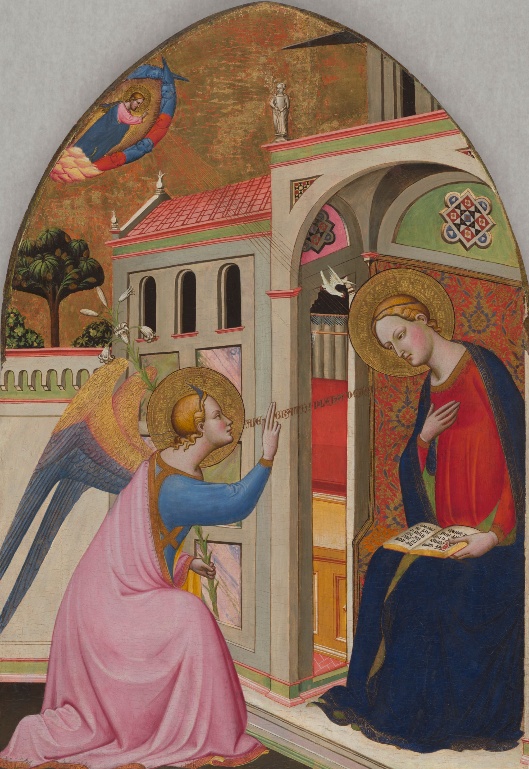
How do Mary’s words (line 45) emphasize her humility?
Calling herself the “handmaid of the Lord” makes her an embodiment of that virtue. [Dante, as did most contemporary Catholics, believed in the Immaculate Conception of Mary, a doctrine not made official Roman Catholic doctrine until 1854. As Ronald Martinez has said, “her soul imposes its (humility’s) form on her body as completely as if her body were wax,” commenting on lines 43-44.]
- 3. What is the subject of the second carving Dante sees on the wall (lines 47-69)?
It is the scene of David dancing before the Ark of the Covenant as it is transported to Jerusalem.
What is its purpose?
Like the previous work, its purpose is to exemplify humility. David the king humbles himself to dance before the Lord. (In contrast, Michal, who disapproves of David’s behavior, God curses with barrenness.)
What unique quality does the second carving share with the first (lines 58-64)?
They, too, seem to be alive. Though Dante’s ears say the seven choruses are not singing, his eyes and the nose say they are.
How do lines 64-66 further qualify the subject as one depicting humility?
The dance Dante describes is a lively, jumping dance, according to the critic Singleton. Further, the Vulgate, which Dante uses, translates saltabat as “dancing or leaping.” David, the humble psalmist, has laid aside his kingly dignity (pride) for the humility of his ecstatic dancing, which is disapproved by the prideful Michal. Further, David is down on the level of the people, while Michal looks down upon all from high up.
David, the forebear of Jesus, is a humble king just as Jesus, who is God, lives humbly during his time on Earth.
- 4. What is the subject of the third carving (lines 76-92)?
The subject, well-known in Dante’s time, is Trajan stopped by an importunate widow who seeks justice for her murdered son. This legend helps to turn Trajan into a paragon of doing what is right despite personal goals and ambitions.
What is its purpose (lines 91-93)?
Like the previous two carvings, this one exemplifies humility, this time of an emperor. Trajan exhibits humility in putting aside his military plan to serve an individual’s need for justice and in so doing also shows humble compassion.
- 5. What is Dante saying about all three carvings he and Virgil have just observed in lines 94-99?
He confirms that the images have been made by the hand of God. Dante is moved not only by the beauty of the work but by the beauty of the subject: humility. For him, it requires that he love and respect the artist (as he might with any human artist). His love for God, of course, is transcendent.
- 6. What is the rhetorical device used in lines 106-111?
This is the third apostrophe directed to his readers. It beseeches them not to give up when they see suffering endured by the proud on this tier of Purgatory. He advises us not to dwell on the current suffering but to look toward the glory that awaits them in Paradise.
[You may take issue with the words, “God demands we pay the debt” of our sins. Remember this is a Roman Catholic, not a Lutheran poem.]
What is Dante’s point in lines 121-129?
His metaphor of an insect changing into a butterfly underscores one of Dante’s major themes in the Commedia: spiritual change is metamorphosis.
What do you make of the closing lines 136-139?
Even the most patient seem to be at the limit of their capacity.
Alternatively, those souls suffering the most seem to be at the limit of their capacity, yet they continue in their quest of purification.