Purgatorio, Canto XXI
Class notes on Canto XXI of Dante's Purgatorio.
Canto XXI – Statius
- 1. In the first tercet, Dante alludes to the story of the Samaritan woman at the well. How does Dante use the words thirst and drink in the line 1?
They each refer to knowledge.
Ronald Martinez and many other critics hear in the first line of this canto an echo of the first line of Dante’s Convivio which quotes Aristotle’s Metaphysics:“All men by nature desire to know.” In addition, “it is clear that in this passage Dante identifies the natural desire to know as always including the desire for God. The metaphor of thirst is part of the gradual substitution of physical desire by spiritual desire in the upper reaches of Purgatory.”
Watch for both motifs throughout this canto and the next two.
[See ll. 38-39.]
How does the allusion to an episode in the Gospel of John function here?
Because Christ contrasts the living water he offers to the water in the well visited by the Samaritan woman, a connection can be drawn to the story of Statius in this canto. Medieval exegetes interpreted the episode as “the offering of salvation to the Gentiles in response to their desire for God,” and Dante seems here to apply that interpretation to the case of Statius.
To what episode in the Gospel of Luke do lines 7-15?
The appearance of the risen Christ to the two disciples on the Road to Emmaus.
In the Gospel, when the two disciples (one of them traditionally was identified as Luke himself) return to the Upper Room and tell their story, the Risen Christ appears and says, “Peace to you,” to the assembled disciples.
While the earthquake felt at the end of Canto 20 is explicitly connected to the Nativity, that of the appearance of Christ to the two disciples and later to the others is clearly connected to the Resurrection.
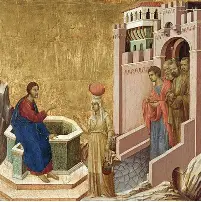
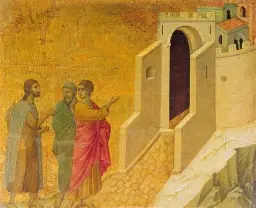
The two episodes were often paired in medieval painting as the two panels above from Duccio di Buoninsegna’s Maestà** demonstrate. (Both paintings are in public domain.)
- 2. In lines 34-36, Virgil asks Statius why “the mountain recently/shivered so hard.” How does Statius begin to answer this question in lines 40-54?
By divine ordinance, Purgatory is exempt from ordinary physical change.
There is no precipitation above St. Peter’s gate. None of the regular meteorological events of Earth occur there.
How does Statius finally answer Virgil’s question? (lines 55-60)
Lines 55-57 reflect the medieval explanation of earthquakes as caused by subterranean winds.
Lines 58-60 hold on to that explanation but also note that whenever a soul completes its purgation and is free to ascend the mountain all the souls in Purgatory shout joyfully. Together, these lines recall the earthquake at the Crucifixion.
How do lines 61-66 explain how a soul comes to leave?
As long as a soul holds on to its yearning to sin, it remains under the purgative punishment of Purgatory. When the soul comes to realize it is free of that yearning, its will is entirely free. In Dante’s Catholic terms, the soul has completed “satisfaction” for its sin.
Statius died in AD 96. How long has he spent among the avaricious (lines 67-70)?
He testifies to having spent 500 years among the avaricious.
In Canto 22, we will learn he must spend 400 years among the slothful before that.
How do Statius’ words satisfy Dante’s thirst for knowledge? (lines 73-75).
Statius’ explanations have done so by responding to lines 1-3.
- 3. Statius just gave a very long answer to Virgil’s question about the earthquake. What is his next question? (lines 79-81)
These lines actually contain two questions. First, he wants to know who this as yet unnamed person was in life. Second, he asks, “why all those centuries have found you here?”
How does he identify the time in which he lived? (lines 82-84)
Statius connects his own career with the rebellion of Judaea and the siege and destruction of Jerusalem by the Roman general Titus, son of Emperor Vespasian.
What does Statius reveal about himself in lines 85-93?
First, he was a poet of considerable fame. Indeed, Statius claims that Rome summoned him from Toulouse, although historical sources place his origins in Naples, to honor him publicly with poetic honors.
Finally, in lines 91-93, he identifies himself as Statius, author of the Thebaid and the Achilleid, the first an epic poem about the battles for Thebes ensuing after the fall of Oedipus and the second an unfinished epic about Achilles.
- 4. In lines 94-99, Statius does homage to Virgil as his inspiration. How does he describe that influence?
Dante bases Statius’ praise of the Aeneid on the concluding apostrophe of the Thebaid: “Live, I pray, nor strive with the divine Aeneid, but follow from afar and always adore its footprints.”
How does he praise the Aeneid?
He refers to Virgil’s epic as his mother and nurse. “Without it, all my work weighs not a dram.”
What remarkable claim does he further make about his high regard for Virgil in lines 100-102?
He claims he would gladly have had a year added to his time of penitential suffering in Purgatory to have lived as a contemporary of Virgil.
How does Statius react to Dante’s revelation in identifying Virgil (lines 124-131).
He kneels and embraces Virgil’s feet.
You may find the presentation on Canto XXI in the 100 Days of Dante series here.