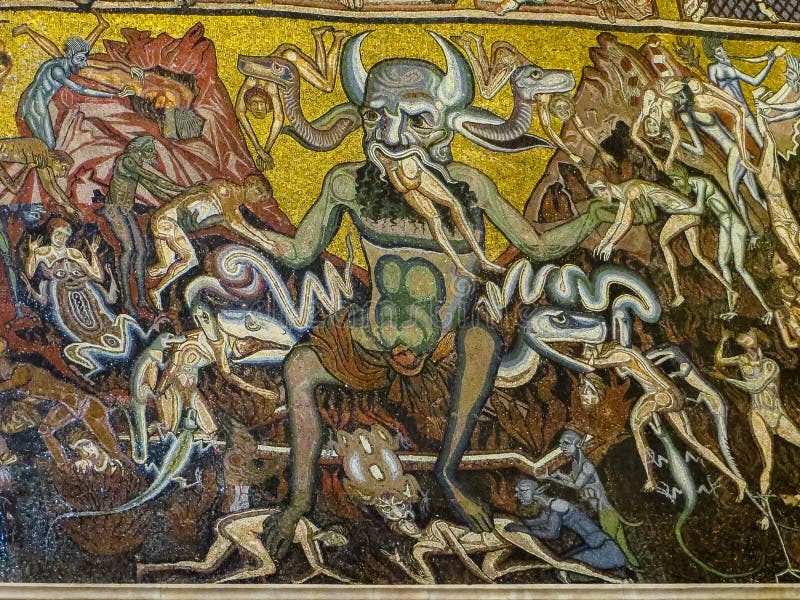
The Three Faces of Satan
Readings of the red, yellowish-white, and black faces of Lucifer in Inferno 34.
Parodic Trinitarian Interpretations
| Color | Correlation to Trinity | Values |
|---|---|---|
| Red | Perversion of the Father | Wrath, violence, bloodshed Opposing the Father’s justice |
| Yellowish-white | Perversion of the Son | Envy, treachery, or false light Opposing Christ’s true light |
| Black | Perversion of the Holy Spirit | Despair, darkness, or negation of charity Opposing the Spirit’s love |
Correlation to the Crucified Christ Interpretation
| Color | Correlation |
|---|---|
| Red | Christ’s blood |
| Yellowish-white | Christ’s flesh |
| Black | Christ’s bruises |
Dante draws from a well-established tradition of “the devil on the Cross.”
Moral-Psychological Interpretations
| Color | Sin | Values |
|---|---|---|
| Red | Violence | Blood, rage, bodily harm |
| Yellowish-white | Fraud | Sickly, deceptive coloration; the “pallor of treachery” |
| Black | Treachery | Darkness as the deepest moral corruption |
Political – Historical Interpretations
| Color | Faction |
|---|---|
| Red | Ghibelline |
| Yellowish-white | White Guelphs |
| Black | Black Guelphs |
Lucifer’s faces symbolize the fracturing of Christendom and the political treachery Dante saw as diabolically inspired.
Expansion of the Symbolic – Cosmological Interpretation
| System | Red | Yellowish white | Black | Note |
|---|---|---|---|---|
| The Four Humors (minus one) | Sanguine (blood) | Choleric (yellow bile) | Melancholic (black bile) | Phlegm omitted because Lucifer is frozen |
| The Elements | Fire | Air | Earth | Water is present in the lake of Cocytus |
| Medieval ethnographic color symbolism | Europe (ruddy) | Asia (yellowish) | Africa (dusky) |
Aesthetic – Poetic Interpretations
- The three faces parody the six-winged seraphim of Isaiah 6:2.
- The colors represent the collapse of beauty into grotesque fragmentation.
- Lucifer is the anti-image of divine harmony.
The Philological Interpretations
| Color | Dante’s Signal |
|---|---|
| Red | Dante’s signal for passion, violence, or martyrdom |
| Yellow and white | Dante’s signal for sickness, decay, or false purity |
| Black | Dante’s strongest marker of evil, privation, and non-being |