Greek Drama Daily Plans
Thirteen days of lesson plans guide a class through Greek drama and the Oresteia.
Day 1
Assignment to have been completed: Students should have read “Background - The Greek Theater” and “Drama Definitions.”
Activities:
- A. Administer quiz over today’s reading assignment. If you do not find these in this plan folder, look for them in the top drawer of the left-hand four-drawer filing cabinet. They will be in a pink-tabbed folder entitled “Greek Theater.”
- B. Go over the study questions for today’s reading assignment. A student has been assigned each of these questions. Solicit their answers first. Compare it to the basic answers I have supplied below. If my answer differs greatly from the answer offered by a student, read my complete answer to the class. If the student answer contradicts or leaves out information, again read my answer - at least the significant parts. If you feel more comfortable just reading all of my answers, you may do that too.
Introduction to the Greek Theater
- 1. Define play.
A play is a set of words to be spoken by actors which pretends to unfold certain events as well as the thought and feelings of two or more characters.
Specifically, how does modern theater differ in purpose from ancient Greek theater?
The ancient Greek theater was an expression of religion. It sought to produce an idealized, that is, heightened representation of life (not a naturalistic one).
Who produced, performed, and viewed the ancient Greek dramas when they were first created?
The dramas were produced, performed, and viewed by citizens.
What motivated those ancient playwrights to create?
Playwrights were motivated by love of their art and hope of renown, not for financial success or as a livelihood.
- 2. What element of plot served instead of suspense in Greek dramas?
Anticipation replaced suspense.
How did the Greek treatment of violence differ from our own?
Greek dramatists concentrated on how a thing was done rather than on what was done. They never showed violence; they had the characters discuss it.
- 3. Which citizens could not serve as actors?
Female citizens were not permitted on stage.
How did the presentation of the plays differ from the way in which plays are presented today?
Greek plays were always presented outdoors. The actors wore masks (easily allowing an actor to play more than one role). All Greek plays were presented without intermission. The lines of the Chorus were sung - and those of the actors were spoken.
What concept did Greek drama tend to reinforce?
Like some modern dramatists, however, the Greek writers reinforced man’s belief in the values of living.
- 4. From the worship of which of the Olympian gods did Greek drama arise?
Greek drama arose from the worship of Dionysus.
Who is traditionally reputed to have introduced the first actor? What title does he merit?
Thespis is credited with being the “Father of Drama” because he is reputed to be the first to separate an actor from the chorus.
According to Aristotle, who intensified dramatic conflict by introducing the second actor?
Aristotle credits Aeschylus with introducing the second actor.
- 5. Upon what sources did the Greek dramatists draw for their subjects?
The Greek dramatists drew their subjects principally from mythology but did sometimes draw from history.
Who was their favorite source?
Homer was their favorite source.
- 6. What is hubris?
Hubris (also spelled hybris) is overweening self-assertion or pride in a character (always the principal character).
- 7. What devices and techniques did Greek actors use to depict character and to display feelings?
The manipulation of sound through rigorous training - fasting, dieting, voice- testing - helped Greek actors to depict character and feelings. They also wore masks that stylized a character’s predominant features.
What was an actor’s most valuable asset?
An actor’s most valuable asset was his voice.
- 8. List the functions of the chorus.
The chorus served many functions:
- a. intermediary between characters
- b. representative of “man on the street”
- c. commentator on action
- d. purveyor of information
- e. provider of summaries
- f. spokesman of poet
- g. underliner of action
- h. commentator on characters
- i. emphasizer of emotional and moral implications
- j. giver of relief from dramatic tension
- k. doubler of emotional involvement of audience
- 9. Name the three great Greek tragedians whose combined thirty-three extant plays constitute our only examples of classical tragedy.
The three great tragedians were Aeschylus, Sophocles, and Euripides.
Who was the single comic dramatist contemporary to those same tragedians whose work remains extant?
Aristophanes was the comic dramatist contemporary with them.
Which tragedians won the prize most often?
Sophocles won most often (24 times).
For which play did Aeschylus receive his last prize?
Aeschylus won his last prize for the Oresteia.
Why did the original Greek audiences seem to reject the works of Euripides?
Euripides’ work seems to have been too psychological and modern for his audience’s taste.
- 10. Greek culture spread most quickly after the fall of which city and center of culture?
Greek culture spread most rapidly after the fall of Athens (due largely to the conquests of Alexander the Great).
- C. Go over the study guide questions for “Drama Terms.”
- 1. Differentiate between the general term drama and the specific term tragic drama.
A drama is any composition in prose or verse that portrays life or characters by action and dialogue while a tragic drama must also have a serious tone.
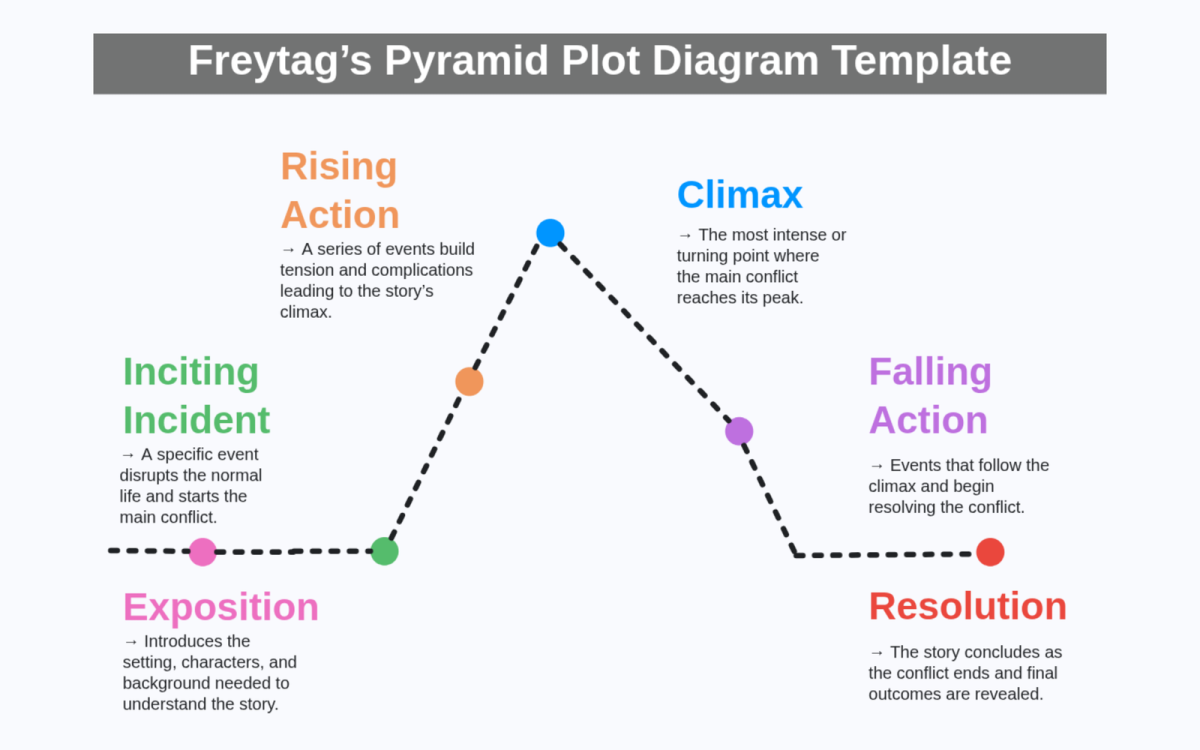
- 2. Label the following diagram using these terms: exposition, inciting force, complication, crisis, climax, resolution, catastrophe, and conclusion. Explain each term and its role in the plot thoroughly.
Simply refer to “Definitions - Drama Terms” in the study guide for explanation of terms.
- 3. Define conflict.
Conflict - the struggle between two opposing forces in a drama
What is the function of conflict in a drama?
Conflict provides interest and suspense.
What are the four major types of dramatic conflict?
- A. the opposition of physical forces
- B. the opposition of character elements
- C. the opposition of internal forces (spiritual struggle)
- D. the opposition of fate and will
Cite examples of each from the reading we have done so far in the course - or from reading you have done outside the course.
Examples will, of course, vary.
- 4. Differentiate between protagonist and antagonist.
The protagonist is the central character, and the antagonist is the principal character or force that opposes the protagonist.
In addition, use a dictionary to discover their etymological meanings; apply those meanings to their usage in the drama.
Protagonist may be traced to the etymological meaning “first actor,” while antagonist may be traced to the meaning “contender against.”
- 5. List and thoroughly explain each of Aristotle’s three unities.
UNITY OF TIME: the ideal play should unfold over a period of no more than one day
UNITY OF PLACE: the ideal play should transpire in no more than one location
UNITY OF ACTION: the ideal play should present no more than one main action, with no subplots
- 6. Explain catharsis. Use a movie you have seen that achieves catharsis to explain the term.
Catharsis is the release and relief of emotion achieved through vicarious participation in the action of the drama. [The examples, of course, will vary.]
- 7. Explain Aristotle’s five criteria for a good protagonist.
[See the rules on the second page of “Drama Terms” in the packet.]
Does Odysseus fit these criteria? Does Moses? Does Gilgamesh?
Odysseus is not truly a tragic hero since he triumphs. Neither is Moses. However, it may be argued that Gilgamesh is by the point that he does not attain his goal.
Assignment for next class meeting: Read the “History of the House of Atreus.”
Day 2
Assignment to have been completed: Students should have read the “History of the House of Atreus.” They should also have studied the genealogical chart and answered the study questions
Activities:
- A. Administer quiz over today’s reading assignment.
- B. Go over the study questions for this assignment. I have provided “best” responses for each. Encourage the students to give their own answers rather than just reading mine to them.
- 1. Who is the earliest ancestor of the House of Atreus? What is his sin?
Tantalus - blasphemy and hubris: he fed his son to the gods
- 2. What is Niobe’s sin?
hubris and blasphemy: she claimed her fourteen children rated her greater respect than Latona’s twins rated her
How does her story connect with the Odyssey?
She is the grandmother of Nestor and the great-grandmother of Peisistratos, Telemachos’ companion on his journey to Lacedaimon.
- 3. Who is Pelops?
Pelops is Tantalus’ son.
What is his sin?
lying and murder: he deceived the charioteer and then murdered him
- 4. What is Hippodamia’s sin?
murder: She killed one of Pelops’ illegitimate sons, fearing he would usurp her son’s rightful position.
- 5. List the sins of Atreus. Be prepared to explain the story behind each.
murder and conspiracy to commit murder
- 6. List the sins of Thyestes. Be prepared to explain the story behind each.
rape, conspiracy to commit murder, murder, treason
- 7. What reasons did Clytemnestra have to dislike Agamemnon?
He had murdered her first husband and sacrificed their daughter in an effort to secure good winds for the fleet bound for Troy.
- C. If time permits, have the students turn to 21 in their packets and p. 41 in their books. Then proceed to item B on the next day’s daily plan.
Assignment for next class meeting: Read any of pp. 41 - 60 not read in class today. Do the corresponding study questions.
Day 3
Assignment to have been completed: Students should have read pp. 41 - 60 in the Agamemnon and the corresponding study questions: 1 - 6.
Activities:
- A. Begin reading the Agamemnon aloud. Use student volunteers. Ask the following questions at the indicated points as the reading progresses. Encourage the students to write down questions to ask me when I return tomorrow. The boldface sentences indicate the points in the play to which the questions correspond.
At the end of the Watchman’s speech on p. 42…
- 1. How does the Watchman feel about Clytemnestra?
The Watchman regards Clytemnestra as occupying a reversed role: she has assumed the prerogatives of a man.
About Agamemnon?
He yearns for Agamemnon’s return, confident that the king will put all things right.
About the current situation in Argos?
He says that Argos has fallen on hard times - an allusion to Clytemnestra’s and Aegisthus’ tyranny.
At the top of p. 43 - immediately after the stage directions…
2. Who comprises the chorus?
The Chorus consists of the Argive Elders, old men of the city who were too old when the Trojan War began to go and fight.
At the end of p. 43…
Whom do they blame for the war?
They blame Paris - who violated the cod of hospitality by seducing his host’s wife - and Helen - who behaved adulterously. [As the play progresses, they heap more blame on Helen.]
At the end of the second stanza on p. 44…
Whom do they blame for the war?
They view themselves as too weak to act.
At the break between the lines on p. 46…
3. What is the meaning of the omen of the eagles and the hare?
The omen of the eagles and the hare foretells that Agamemnon and Menelaus, the Atreidae, will utterly destroy Troy - but at a great price that will bring down a curse on the family. Their triumphal conquest must begin with the sacrifice of one of their children.
Which goddess, in particular, disapproves of the sacrifice?
Artemis abominates such a sacrifice - although we get the idea that Agamemnon’s prophet indicated that she had demanded a sacrifice.
After the last complete stanza on p. 48…
What is the connection between truth suffering?
“Man must suffer to be wise.” As does the Book of Job, Aeschylus says that adversity strengthens character.
After the last full stanza on p. 50…
- 4. What is Agamemnon’s dilemma?
Agamemnon’s dilemma lies in abandoning the Trojan campaign which would label him a coward or sacrifice his daughter (ironically) to Artemis to get a favorable wind - which act would make him an unnatural murderer.
How does he justify his decision?
He justifies his decision to sacrifice Iphigenia (his elder daughter) that his military honor and political duty require this deed.
Does the Chorus regard his decision as righteous?
The Chorus recognizes the impiety of Agamemnon’s action.
After the Chorus’s last speech on p. 52…
- 5. How does the Chorus initially react to Clytemnestra’s news?
Initially, the Chorus refuses to believe Clytemnestra’s news of Troy’s fall.
What does their reaction tell you about their attitudes toward Clytemnestra?
They doubt her ability to have gained reliable news. After, all they might say, “She is just a woman…”
Just before the Chorus speaks at the top of p. 55…
- 6. The Greek placed high value on MODERATION. How does Clytemnestra’s vision of the defeated Trojans touch on that idea?
Clytemnestra envisions wholesale killing and plundering by the Greeks and hopes they will not exceed the limits that the gods allow. (For example, she hopes they will not plunder temples or utterly annihilate Troy - both of which the Greeks did do. [The audience knows that the Greeks did these things. Consequently, they note the irony of her words, doubly so when they recall that Clytemnestra wants her husband dead.]
After the second break on p. 58…
How did the people of Argos begin to feel about the Trojan War during its ten year span? Why?
The Argives themselves knew primarily the cost in lives of husbands, sons, and brothers in contrast to the adultery of Helen. Grief and resentment have replaced outrage and war-lust.
Assignment for next class meeting: Write out complete answers to study questions 1- 6 in your own words.
Day 4
Assignment to have been completed: Students should have read pp. 61 to the end of the play in the Agamemnon and the corresponding study questions: 7 - 12.
Activities:
- A. Administer quiz over yesterday’s reading. Quizzes can be found either in the top drawer of the filing cabinet immediately to the right of my desk or in the top drawer of the first four-drawer filing cabinet against the fabric-covered wall in a pink-tabbed file labelled Agamemnon 1. Allow students about five to seven minutes to complete the quiz. Then collect the quizzes and place them - paper-clipped - in the top drawer of the filing cabinet immediately to the right of my desk.
Activities:
- B. Continue reading the Agamemnon aloud, starting at the stage direction in the middle of p. 60. Use student volunteers. Ask the following questions at the indicated points as the reading progresses. Compare it to the basic answers I have supplied below. If my answer differs greatly from the answer offered by a student, read my complete answer to the class. If the student answer contradicts or leaves out information, again read my answer - at least the significant parts. Encourage the students to write down questions to ask me when I return tomorrow. The boldface sentences indicate the points in the play to which the questions correspond.
Just before the Chorus’s first speech at the bottom of p. 61…
- 7. Does the Herald feel the punishment meted out by the Atreidae fits Paris’s crime?
The Herald states that the punishment was twice as great as the crime.
What is his reasoning?
He observes that his punishment for robbery - kidnapping (?) Helen - meant the utter destruction of Troy and Paris’s family.
At the break toward the bottom of p. 62…
In what specific images does the Herald describe the condition the soldiers of Agamemnon’s army faced?
He describes the soldiers’ circumstances in terms of disease, discomfort, dirt, sleeplessness, dampness, and cold.
At the point Clytemnestra exits on p. 64…
- 8. How does Clytemnestra use irony in her first speech about Agamemnon’s return?
The message Clytemnestra sends to Agamemnon is the exact opposite of her true behavior in his absence. However, the audience knows the truth and may see the grain of twisted truth in each line.
What is ironic about the disappearance of Menelaus?
It is ironic that Menelaus disappeared since it was on his behalf that the Greeks conquered Troy. They had spent ten years to retrieve Helen, only to have her possibly lost at sea.
At the end of the Herald’s speech at the top of p. 66…
What is ironic about Agamemnon’s safe escape from the storm?
Agamemnon escapes the natural disaster that delays everyone else returning from Troy, only to sail directly home and into the ultimate human disaster - murder.
At the break in the middle of p. 68…
- 9. In their conversation with the Herald, whom does the chorus blame for the evils of the war?
In a long ode, the Chorus condemns Paris and - especially - Helen for all the suffering associated with the war.
Just before Agamemnon speaks on p. 70…
When the Chorus greets Agamemnon, what do they have to say about appearances?
The Chorus warns Agamemnon that some joyful faces may actually mask treacherous bitterness against him.
What do they have to about the sacrifice of Iphigenia?
They further tell him that his sacrifice of Iphigenia was regarded as “wrong, misguided.”
What do they have to about the situation in Argos?
They conclude by telling Agamemnon that he will need to sniff out the traitors in Argos. [Recall that Odysseus had Eumaios, Philoitios, and especially Eurycleia to help him with this task on Ithaca.]
At the first break on p. 71…
- 10. To whom does Agamemnon attribute the sack of Troy?
Agamemnon attributes the sack of Troy to the will of the gods.
At the last break on p. 71…
What does Agamemnon have to say about power/prosperity and envy?
Agamemnon observes that time has taught him that power/prosperity begets envy in others. He has the skill to distinguish the loyal from the envious traitors.
In what way is this attitude ironically prophetic?
He is right about prosperity giving rise to envy. It is unlikely, however, that he expects that envy in his wife.
Just before Clytemnestra speaks on p. 72…
How does he propose to go about resuming his kingship?
He proposes a general assembly and inquiry to determine the traitors - whom he will then execute. [He assumes a smooth return to power - unlike Odysseus who knew he would face opposition.]
At the first break toward the bottom of p. 72…
- 11. How does Clytemnestra publicly describe her experiences while Agamemnon was at war? Why?
Clytemnestra describes her grief as she heard uncounted rumors of Agamemnon’s wounding and death. She goes so far as to claim she often considered suicide because she worried so for him. She is obviously diverting and suspicion from her own treachery.
After the last line on p. 72…
Where is Orestes? Why?
Orestes she has sent to Strophius the Phocian whom she claims warned her that Agamemnon’s death or civil upheaval would lead the people to wish Orestes dead.
After Clytemnestra’s first speech on p. 74…
How is the argument between Agamemnon and Clytemnestra concerning the tapestries related to the Greek concept of hubris?
Agamemnon claims that walking on the precious cloth would indicate that he presumes god-like prerogatives, which would be regarded by the gods as excessive pride - hubris.
At the first break on p. 75…
How is Agamemnon’s reservation proven to be motivated more by politics (even economics) than by piety?
A crafty politician, Agamemnon is concerned that his people may perceive such an action as arrogant. (He may also be concerned about wasting precious cloth.) [It is noteworthy that it does not take Clytemnestra long to persuade him.]
Before Clytemnestra’s first speech on p. 76…
- 12. What is irony of Clytemnestra’s triumphant cry and prayer to Zeus?
Ironically, the Chorus interprets Clytemnestra’s triumphant cry “as a formal celebration of the victor’s return” while Cassandra - and the audience - knows that Clytemnestra is celebrating her first triumph of will over Agamemnon and her impending triumph over his life.
Before the Chorus’s last speech on p. 78…
What attitude does Clytemnestra take in facing Cassandra?
She takes a condescending attitude toward Cassandra, reminding the captive princess of Troy of her former wealth and of her present slavery. She also jabs at Cassandra’s mind, suggesting that she is insane. Finally, she launches the ultimate Greek insult - she calls Cassandra a foreigner.
At the end of Clytemnestra’s first speech on p. 78
What is the irony of Clytemnestra’s reference to victims waiting at the hearth?
The irony of her reference to the victims at the hearth is that the Chorus assumes she means animals, but we know she means Agamemnon and Cassandra.
Assignment for next class meeting: Write out answers in your own words to study questions 7 - 12.
Day 5
Assignment to have been completed: Students should have prepared answers in their own words to study questions 7 - 12.
Activities:
- A. Administer quiz over yesterday’s reading. Quizzes can be found either in the top drawer of the filing cabinet immediately to the right of my desk or in the top drawer of the first four-drawer filing cabinet against the fabric-covered wall in a pink-tabbed file labelled Agamemnon 2. Allow students about five to seven minutes to complete the quiz. Then collect the quizzes and place them - paper-clipped - in the top drawer of the filing cabinet immediately to the right of my desk.
- B. Continue reading the Agamemnon aloud, starting at the stage direction in the middle of p. 79 where Clytemnestra enters the palace. Use student volunteers. Ask the following questions at the indicated points as the reading progresses. Compare it to the basic answers I have supplied below. If my answer differs greatly from the answer offered by a student, read my complete answer to the class. If the student answer contradicts or leaves out information, again read my answer - at least the significant parts. Encourage the students to write down questions to ask me when I return tomorrow. The boldface sentences indicate the points in the play to which the questions correspond.
- 13. What is Cassandra’s blessing-and-curse?
Cassandra was loved by Apollo who gave her the gift of prophecy. However, when she rejected the god, he could not take back his gift, but he cursed Cassandra so that she would never be believed. (84)
How does Aeschylus depict it as Cassandra speaks with the Chorus?
The Chorus perceives words that are clear in their meaning to the audience as unintelligible riddles or insane gibberish. (80 - 85)
What prophecy about vengeance against her murderers does she make?
She prophesies that Orestes will return to kill his father’s killers. (87)
- 14. How does the Chorus react to the sounds of Agamemnon’s death groans?
The varying opinions on what to do reflect the Chorus’s general confusion. In the end they resolve among themselves to make a “full enquiry,” something that is likely to be as ineffectual as their discussion. (89 - 90)
With what attitude does Clytemnestra publicly announce her murderous actions?
Clytemnestra calmly and coolly explains her plan and declares that justice was her motive. She is also indignant that the Chorus dares to condemn her when they said nothing of Agamemnon’s sacrifice of Iphigenia. (90)
How does Clytemnestra identify herself with the curse on the House of Atreus? Why?
Atreus, Agamemnon’s father, had killed his nephews to avenge their father’s (his own brother’s) adultery with his wife. Clytemnestra has taken vengeance on Agamemnon, another child-killer. In this way she further justifies herself. (94)
What is Aegisthus’s claim against Agamemnon’s life?
Aegisthus sees Agamemnon’s murder as just payment for Agamemnon’s father’s murder of Aegisthus’s brothers. (97)
What accusation does the Chorus make against Aegisthus, completing their accusation of calling Clytemnestra man-like?
The Chorus calls Aegisthus a woman - as earlier they had called Clytemnestra a man. (98)
- 15. Who seems to be more in control - more ruled by reason: Aegisthus or Clytemnestra? How so?
Clytemnestra seems more ruled by reason while Aegisthus responds emotionally to the Chorus. (100)
Can Clytemnestra make good on her closing declaration?
This question is OPEN. It is unlikely, however, that tyrants can ever earn “reverence.” (100)
Assignment for next class meeting: Read pp. 103 - 124 in the Libation Bearers. Do the corresponding study questions: 1 - 7a.
Day 6
Assignment to have been completed: Students should have read pp. 103 - 124 of the Libation Bearers and should have prepared study questions 1 - 7a.
Activities:
- A. Administer quiz over yesterday’s reading. Quizzes can be found either in the top drawer of the filing cabinet immediately to the right of my desk or in the top drawer of the first four-drawer filing cabinet against the fabric-covered wall in a pink-tabbed file labelled Libation Bearers 1. Allow students about five to seven minutes to complete the quiz. Then collect the quizzes and place them - paper-clipped - in the top drawer of the filing cabinet immediately to the right of my desk.
- B. Read aloud from the Libation Bearers, starting at p. 103. Use student volunteers. Ask the following questions at the indicated points as the reading progresses. Compare it to the basic answers I have supplied below. If my answer differs greatly from the answer offered by a student, read my complete answer to the class. If the student answer contradicts or leaves out information, again read my answer - at least the significant parts. Encourage the students to write down questions to ask me when I return tomorrow.
Activities:
- 1. What is the double significance of Orestes’ placing a lock of hair on his father’s grave?
The first lock of hair represents the passage from childhood to adulthood. The second symbolizes Orestes’ mourning of his father. [The cutting - or shaving - of hair was part of both the ritual of manhood and that of mourning.] (103)
How are the two meanings appropriately similar (or linked in significance)?
Now that Orestes has ritually declared his manhood and officially recognized his father’s death, he is bound as a man to take vengeance on his father’s killer. (critical thinking)
- 2. Who constitutes the Chorus?
The Chorus consists of captive Trojan women - now servants. (103)
Why have they come to mourn at Agamemnon’s tomb?
Clytemnestra has sent them to perform funeral rites at Agamemnon’s grave out of fear of vengeance, fear inspired by a dream. (104)
How do they feel about Agamemnon?
They regard Agamemnon as a rightful king wrongly deposed and murdered. They respect him and genuinely mourn him. (104 & 107)
How is their attitude ironic?
This attitude seems ironic in view of the fact that Agamemnon lead the forces that destroyed their home and took them captive after killing their male family members. (critical thinking)
How do they feel about Clytemnestra and Aegisthus’s rule?
They see Clytemnestra and Aegisthus as usurping tyrants. (106)
How does Electra feel about the pair?
Electra feels her mother has “sold” both her and her brother. She feels both of them deserve to die. (108 & 109)
- 3. Why is there a dilemma over the identity of the lock of hair found on the grave by Electra?
The hair could belong to either Orestes or Clytemnestra. It gives rise to both hope and despair. (110 - 111)
How does Orestes’ revelation of himself to Electra parallel Odysseus’s revelation of himself to Penelope?
Though Electra (like Penelope) has long awaited Orestes’ avenging return, she is suspicious of his claim to be Orestes. [After all, she has lived dome time under a tyranny.] He shares with her the secret of the cloth (as Odysseus shared the secret of his wedding bed). (critical thinking)
- 4. Does Electra prove of Agamemnon’s sacrifice of Iphigenia?
Electra does not approve of Agamemnon’s sacrifice of Iphigenia. In fact, she considers it cruel. (112)
Why is Electra overjoyed to see Orestes’ return?
She is elated at Orestes’ return because he has saved her from dishonor: surely he will avenge their father’s murder. (112 & 113)
For what does Orestes pray to Zeus?
He prays that Zeus give him and Electra the vengeance that their father’s piety deserves. (112 -113)
Who sent Orestes home to Argos? Why?
Apollo sent Orestes home to take vengeance on Agamemnon’s murderers. (113)
What consequences does he face if he refuses?
If Orestes fails, Apollo has promised he will face a life of endless torment, including exclusion from social intercourse and worship. (113)
What motives (“cravings”) does Orestes have for seeking the lives of Clytemnestra and Aegisthus?
Orestes’ motives include Apollo’s command, grief, lost inheritance, shame on behalf of the proud Argives’ suffering under unjust and unnatural tyrants. (114)
- 5. Identify the “brace of women” who dominate the Argive heroes of the Trojan War.
Clytemnestra and Aegisthus constitute the “brace of women.” (114)
How would the Chorus probably define justice?
The Chorus defines justice with “an eye for an eye” - or vengeance. (114 - 115)
What is the purpose of the “rally” chanted by the Chorus, Orestes, and Electra?
The purpose of the responsive chanting is to bolster all their spirits, but especially to encourage Orestes to carry out his unhappy duty to take his mother’s life. (critical thinking)
What was offensive about Clytemnestra’s burial of Agamemnon’s body?
Clytemnestra arranged no funeral procession or formal mourning; moreover she mutilated the body. [She cut off his hands and strung them from his armpits so as to disable any ghostly vengeance.] (119)
By the end, to whom are the Chorus, Orestes, and Electra praying?
By the end they are praying to Agamemnon. (120)
- 6. What are the details of Clytemnestra’s dream?
Clytemnestra dreamed she gave birth to a snake that she treated like a child. It bit her while she nursed it. (122 - 123)
Interpret it.
The snake is Orestes who, though nursed at her breast, must be Clytemnestra’s destined murderer. (123)
What was the dream’s immediate effect on her?
Clytemnestra immediately sent libations to Agamemnon’s tomb out of sheer terror. (123)
- 7. What are Orestes’ plans?
Electra is to fend off suspicion. Orestes will come disguised with Pylades to gain admission to the palace as a suppliant of the code of hospitality. Once in he will seek vengeance. The Chorus is to remain silent or arrange misleading information. (123 & 124)
Assignment for next class meeting: Finish the Libation Bearers. Do the corresponding study questions: 7b - 14.
Day 7
Assignment to have been completed: Students should have completed the Libation Bearers and should have prepared study questions 7b - 14.
Activities:
- A. Administer quiz over the reading. Quizzes can be found either in the top drawer of the filing cabinet immediately to the right of my desk or in the top drawer of the first four-drawer filing cabinet against the fabric-covered wall in a pink-tabbed file labelled Libation Bearers 2. Allow students about five to seven minutes to complete the quiz. Then collect the quizzes and place them - paper-clipped - in the top drawer of the filing cabinet immediately to the right of my desk.
- B. Read aloud from the Libation Bearers, starting at the bottom of p. 124. Use student volunteers. Ask the following questions at the indicated points as the reading progresses. Compare it to the basic answers I have supplied below. If my answer differs greatly from the answer offered by a student, read my complete answer to the class. If the student answer contradicts or leaves out information, again read my answer - at least the significant parts. Encourage the students to write down questions to ask me when I return tomorrow.
- 7. The Chorus’s long speech following Orestes’ statement of his plans is kind of catalogue. Exactly what does the chorus catalogue?
The Chorus catalogues women who destroyed men in fits of passion. (124 - 126)
- 8. When Clytemnestra greets Orestes (unknown to her ) at the door, what is uncharacteristic about her words?
It is uncharacteristic of Clytemnestra to admit any deference to men. (128)
What is Orestes’ lie to her?
The heart of Orestes’ lie is that “Orestes is dead.” (128)
How is that lie ironic?
Its supreme irony is that the supposed dead man delivers his own “death notice.” (critical thinking)
What is ironic about Clytemnestra’s reaction to it?
Orestes’ safety and return were the furthest from Clytemnestra’s plans. (128)
It is not unusual in Greek drama for the bearer of bad news to be punished - or even killed. How, then, is Clytemnestra’s extension of the Code of Hospitality ironic?
It is ironic that Clytemnestra so sumptuously entertains the bearer of the bad news. (129 and critical thinking)
- 9. What news of Clytemnestra’s private reaction to Orestes’ news does Cilissa report?
Cilissa reports Clytemnestra’s private satisfaction over the news of Orestes’ death. (130)
What are Cilissa’s own feelings?
Cilissa herself is bitterly grieved. (130)
Which character in the Odyssey does she parallel?
Cilissa parallels Eurycleia: both were nurses to a hero presumed dead. (130 and critical thinking)
How, specifically, does the Chorus intervene in the plot of the drama?
The Chorus tells Cilissa to tell Aegisthus to come to hear the travellers’ alone - not with armed guards as Clytemnestra instructed. (131)
- 10. How does Aegisthus’s attitude toward the news of Orestes’ death parallel the Watchman’s and the Argive Elders’ attitudes toward Clytemnestra?
Like the Watchman and the Argive elder in the Agamemnon, Aegisthus is suspicious of the news primarily because it comes through a woman. (134 and critical thinking)
- 11. What tactic does Clytemnestra use in an attempt to dissuade Orestes from reeking vengeance?
Clytemnestra (though ready to kill Orestes) appeals to his sense of filial devotion to this mother. (136)
How does Pylades counter her stratagem?
In Pylades’ only lines in the entire play, he counters Clytemnestra’s ploy by appealing to Orestes’ sense of loyalty to the gods (especially Apollo). (136)
What is Clytemnestra’s second tactic?
Clytemnestra’s second tactic is to remind Orestes that he owes her his life (since she bore him). She also threatens to curse him. (136)
- 12. How does Orestes’ speech directly following the killings compare to Clytemnestra’s speech following the murder of Agamemnon?
Orestes and Clytemnestra both claim to have served justice and fate. However, Orestes seems less cold and cruel. (140 and critical thinking)
What “prop” plays an important role in both speeches?
Both Clytemnestra and Orestes haul out the robe used to entangle Agamemnon. (140)
- 13. What is the significance of the wool and the olive branch?
The wool and olive branch are emblems of the suppliant. (142)
Where is Orestes headed now? Why?
Orestes is headed for Apollo’s shrine and oracle at Delphi to seek refuge as one who has shed a relative’s blood. (142)
What kind of life does Orestes anticipate?
He anticipates the life of an exile. (142)
- 14. What vision drives Orestes mad?
A vision of the Furies drives Orestes mad. (142)
What could be the psychological explanation?
The Furies could be the psychological hounding of a guilty conscience. (critical thinking)
What is nemesis?
Nemesis was the Greek goddess of retributive justice. In current usage it is an inflictor of retribution; an avenger. The Furies (or guilt) are Orestes’ nemesis. (dictionary and critical thinking)
Assignment for next class meeting: Read pp. 147 - 166 of the Eumenides (to the point at which Athena returns with the jury). Do study questions 1 - 6.
Day 8
Assignment to have been completed: Students should have read pp. 147 - 166 of the Eumenides and should have prepared study questions 1 - 6.
Activities:
- A. Administer quiz over the reading. Quizzes can be found either in the top drawer of the filing cabinet immediately to the right of my desk or in the top drawer of the first four-drawer filing cabinet against the fabric-covered wall in a pink-tabbed file labelled Eumenides 1. Allow students about five to seven minutes to complete the quiz. Then collect the quizzes and place them - paper-clipped - in the top drawer of the filing cabinet immediately to the right of my desk.
- B. Read aloud from the Eumenides, starting on p. 147. Use student volunteers. Ask the following questions at the indicated points as the reading progresses. Compare it to the basic answers I have supplied below. If my answer differs greatly from the answer offered by a student, read my complete answer to the class. If the student answer contradicts or leaves out information, again read my answer - at least the significant parts. Encourage the students to write down questions to ask me when I return tomorrow.
- 1. Who is the Pythia? Which god does she serve?
The Pythia is the priestess of Apollo who delivers his oracles.
Why is Orestes at Delphi?
Orestes is as Delphi seeking ritual cleansing and release from guilt.
What advice does Apollo give Orestes concerning a means for ending his misery?
Apollo advises Orestes to go to Athens and there supplicate Athena to help him.
Whom does Apollo send to guide Orestes?
Apollo sends Hermes to guide Orestes.
- 2. How is Clytemnestra treated in Hades?
Clytemnestra is universally despised among the dead - though no shade condemns Orestes.
What is her plea to the Chorus?
She entreats the Furies to pursue Orestes, tormenting his conscience unto death.
Who constitutes the Chorus?
The Chorus is comprised of the Furies.
What is Apollo’s assessment of the Furies?
Apollo finds the Furies loathsome, fit only to occupy Hell.
What do they confess their divine task to be?
They profess their task to be to hound matricides to exile.
Why did they not pursue Clytemnestra?
They did not pursue Clytemnestra because wife and husband are not blood relatives.
What is Apollo’s rebuttal?
Apollo asserts that marriage is more sacred than any oath and that its holiness is confirmed by Zeus and Hera’s marriage.
- 3. How is Orestes’ appearance changed by the time he arrives in Athens? Why?
He is not longer blood-stained. [This symbolizes cleansing.] Time has purified him.
- 4. Who is the mother of the Erinyes (Furies)?
The Erinyes’ mother is Night.
How is this symbolically appropriate?
Since darkness is symbolic of evil, death, gloom, and so forth, it is appropriate that dark Night mothered the incarnations of these concepts.
Do the Erinyes carry out Moria’s (Fate’s) will?
The Erinyes were commissioned by Moira (Fate) and carry out its will.
How long have the Erinyes been doing their duty?
They have done this task since the beginning of time.
- 5. What is Athena’s reaction to the appearance of the Erinyes?
Athena is amazed - though not frightened - by the Furies’ appearance.
What observation does Athena make about the Erinyes’ conception of justice?
Athena observes that the Erinyes desire the form (appearance) of justice in punishment rather than its substance in determining circumstances, motive, means, and so forth.
Who is the first to propose a trial for Orestes?
The Furies are the first to propose a trial.
Who is to be the judge?
Athena is to serve as the judge.
Does Orestes agree?
Orestes agrees to a trial.
What is the danger in deciding against the Erinyes?
Deciding against the Erinyes would bring down their blighting wrath on all of Athens.
How does Athena propose to try the case?
Athena proposes a hearing of witnesses and review of evidence with the decision being made by a jury of Athens’ wisest citizens.
- 6. Where do the Erinyes place loyalty to parents in relationship to the code of hospitality?
The Furies place loyalty to parents and adherence to the code of hospitality on an equal par [the highest].
According to them, what motivates just behavior in order to deserve blessing?
The Furies believe that willing obedience, not constraint, alone merits blessing.
Assignment for next class meeting: Read the rest of the Eumenides and do study questions 7 - 14.
Day 9
Assignment to have been completed: Students should have read pp. 166 - 182 of the Eumenides and should have prepared study questions 7 - 14.
Activities:
- A. Administer quiz over the reading. Quizzes can be found either in the top drawer of the filing cabinet immediately to the right of my desk or in the top drawer of the first four-drawer filing cabinet against the fabric-covered wall in a pink-tabbed file labelled Eumenides 2. Allow students about five to seven minutes to complete the quiz. Then collect the quizzes and place them - paper-clipped - in the top drawer of the filing cabinet immediately to the right of my desk.
- B. Read aloud from the Eumenides, starting on p. 166. Use student volunteers. Ask the following questions at the indicated points as the reading progresses. Compare it to the basic answers I have supplied below. If my answer differs greatly from the answer offered by a student, read my complete answer to the class. If the student answer contradicts or leaves out information, again read my answer - at least the significant parts. Encourage the students to write down questions to ask me when I return tomorrow.
- 7. In what dual capacity does Apollo serve Orestes’ trial?
Apollo serves as both a witness and Orestes’ lawyer.
Which side speaks first in this (or in any) trial?
The prosecution presents its case first.
- 8. Why did the Erinyes not hound Clytemnestra?
The Furies did no hound Clytemnestra because she had not killed a blood relative.
- 9. According to Apollo, who backs up his (Apollo’s) testimony and prophecies?
According to Apollo, Zeus - the Father of the Gods - backs up all of Apollo’s prophecies.
On what grounds does Apollo claim Clytemnestra’s murder of Agamemnon was not the same as Orestes’ murder of Clytemnestra?
Apollo observes that Clytemnestra murdered Agamemnon dishonorably and deceptively. He implies that Orestes was not deceptive in the moment he killed Clytemnestra.
By what argument does he try to prove that Orestes is not blood kin to Clytemnestra?
Apollo asserts that the farther is the true parent and that the mother serves only the role of caretaker (even in pregnancy). He uses Athena, born from Zeus’s head, to validate his argument.
10. According to Athena, what role does fear play in the smooth running of a state?
Athena asserts that fear [of penalty] is the incentive that keeps citizens upright.
What contribution has she just invented to aid in that smooth management?
Trial by jury
11. By what system is the decision reached by the jurors?
[Read the stage directions in brackets on p. 171.]
What is their decision?
The jury is evenly divided; they render no final decision.
How do the Erinyes attempt to influence the jury?
The Furies threaten a plague on Athens.
What is Apollo’s rebuttal?
Apollo insists that the Furies are honored by none of the gods.
Who casts the deciding vote? Why?
Athena casts the tie-breaking vote because the jurors are evenly divided on the question.
In modern American law, what happens when the jury’s vote is split (in the case of a murder trial)?
When the jury is split (a hung jury), a mistrial is declared. The accused is not acquitted, but he does get another trial.
12. What is the first promise made by the newly exonerated Orestes? What is its significance?
Orestes pledges a peaceful alliance between Argos and Athens. This promise underscores the debt Orestes owes the jury.
13. When the Erinyes declare “Curse on you upstart [younger] gods, we see a new point of contention far beyond the case of one accused man,” what is that new point?
The underlying conflict is between TRADITION (represented by the old gods - the Furies are children of Night, one of the oldest of the gods) and CHANGE (represented by the new, male-dominated gods.
How does Athena try to assuage the Erinyes’ anger?
Athena observes that the split decision brings no dishonor.
What special new responsibility does she offer them?
Athena offers the Furies the new responsibility of protecting childbirth and marriage vows.
How is this new duty appropriate to them?
This new responsibility is the positive side (protection/prevention of ill fortune) of their old responsibilities (punishment).
What new name are the Erinyes given? What does it mean?
Athena renames them the Eumenides, “the kindly ones” or “the friendly goddesses.”
- 14. Who constitutes the second Chorus?
The second Chorus is comprised of a procession of young women and children of Athens.
How do they contribute to the conclusion of the Eumenides?
In singing with the former Furies, the second chorus exemplifies a theme of just reconciliation, a major theme of the Eumenides.
How do they contribute to the conclusion of the Oresteia?
The dual chorus also brings to a conclusion, bloodlessly, the cycle of vendetta begun in the Agamemnon.
Assignment for next class meeting: Continue to work on your Oresteia essay.
Day 10
Assignment to have been completed: Students should have read the rest of their independent play.
Activities:
After taking attendance, take students to the library where they should break into their project groups and research the mythological or historical background of their plays and the biographical and literary background of the playwright. The librarians should be of considerable help. You may also suggest the following resources.
* Will Durant’s The Story of Civilization series
* the biographical introductions to the fifth volume of The Great Books of the Western World
* literary criticism of the classical and medieval world found in the reference section of the library
Students may choose to conduct other preparations for their project presentations. If so, remind them that they should begin by discussing the play among themselves.
- identify the major characters (relationships, motivations, limitations, and so forth)
- identify and distinguish between protagonist and antagonist
- identify setting (place, time, and atmosphere)
- establish the most likely themes
Encourage each group to assign someone to record the plot events that members use to explain and to defend their positions on the points listed immediately above. They should use these in deciding what plot events to cover in their presentation to the class. Also try a three-minute freewriting in which each group member writes a summary of the plot; then compare summaries.
Select a leader and assign member responsibilities.
If groups do not seem to be doing anything productive, try to get them back on task. If groups finish research early, you may take them back to the room.
Assignment for next class meeting: Work on group presentations. Continue work on Oresteia essay.
Day 11
Assignment to have been completed: Students should have begun planning their Greek drama project presentations.
Activities:
- A. Have students break up into project groups. They should plan out their presentation step-by-step, making sure they have covered all requirements. [Yes, all members do some oral interpretation.]
- B. Remind students that the group must make its presentation even if one member (or more) is absent. The group must be prepared to fill in the gap. The absent member(s) should make sure he/she/they get any needed materials to the rest of the group.
- C. Ask students if they will need any audio-visual equipment for their presentations. Make those arrangements with the A-V Office in the Media Center today for them, please.
- D. Remind students that all props and costumes must be ready to go AT THE BEGINNING OF THE PERIOD tomorrow.
Assignment for next class meeting: Conclude preparations for project presentations.
Day 12
Assignment to have been completed: Students should have all preparations completed and all props and costumes for the Greek drama projects ready to go AT THE BEGINNING OF THE PERIOD.
Activities:
- A. Get video recording equipment ready to go. [If you have problems, see Mr. Eley.] You should find a tape to be used in the top left-hand drawer of my desk.
- B. Begin presentation of Oedipus. Please feel free to comment on the presentation, especially on effectiveness, informativeness, and clarity as well as on the general behavior of the group. Share your comments with both the students and me. Allow no more than twenty minutes for the presentation.
C. Begin the Medea presentation. Follow the same procedure.
Assignment for next class meeting: Complete Oresteia essay. It is due AT THE BEGINNING OF THE PERIOD TOMORROW.
Day 13
Assignment to have been completed: Students should have all preparations completed and all props and costumes for the Greek drama projects ready to go AT THE BEGINNING OF THE PERIOD. They should also have their Oresteia essays ready to submit at the very beginning of the period.
Activities:
- A. Collect Oresteia essays. [Please write “LATE” on any paper that comes in any time after you have collected them - and indicate the time that you receive the paper.] Place the essays in the top drawer of the filing cabinet immediately to the right of my desk.
- B. Get video recording equipment ready to go. [If you have problems, see Mr. Eley.] You should find a tape to be used in the top left-hand drawer of my desk.
- C. If either of yesterday’s groups - either the Oedipus or the Medea group did not present, that group should go first.
- D. Begin presentation of Lysistrata. Please feel free to comment on the presentation, especially on effectiveness, informativeness, and clarity as well as on the general behavior of the group. Share your comments with both the students and me. Allow no more than twenty minutes for the presentation.
- E. Distribute copies of the Metamorphoses and of the “Ovid Packet.” These can be found on the table immediately to the left of my desk.
Assignment for next class meeting: Read “Background - Ovid” and Book I of the Metamorphoses. Prepare study questions. [Assign each question to a different student for a report tomorrow.]